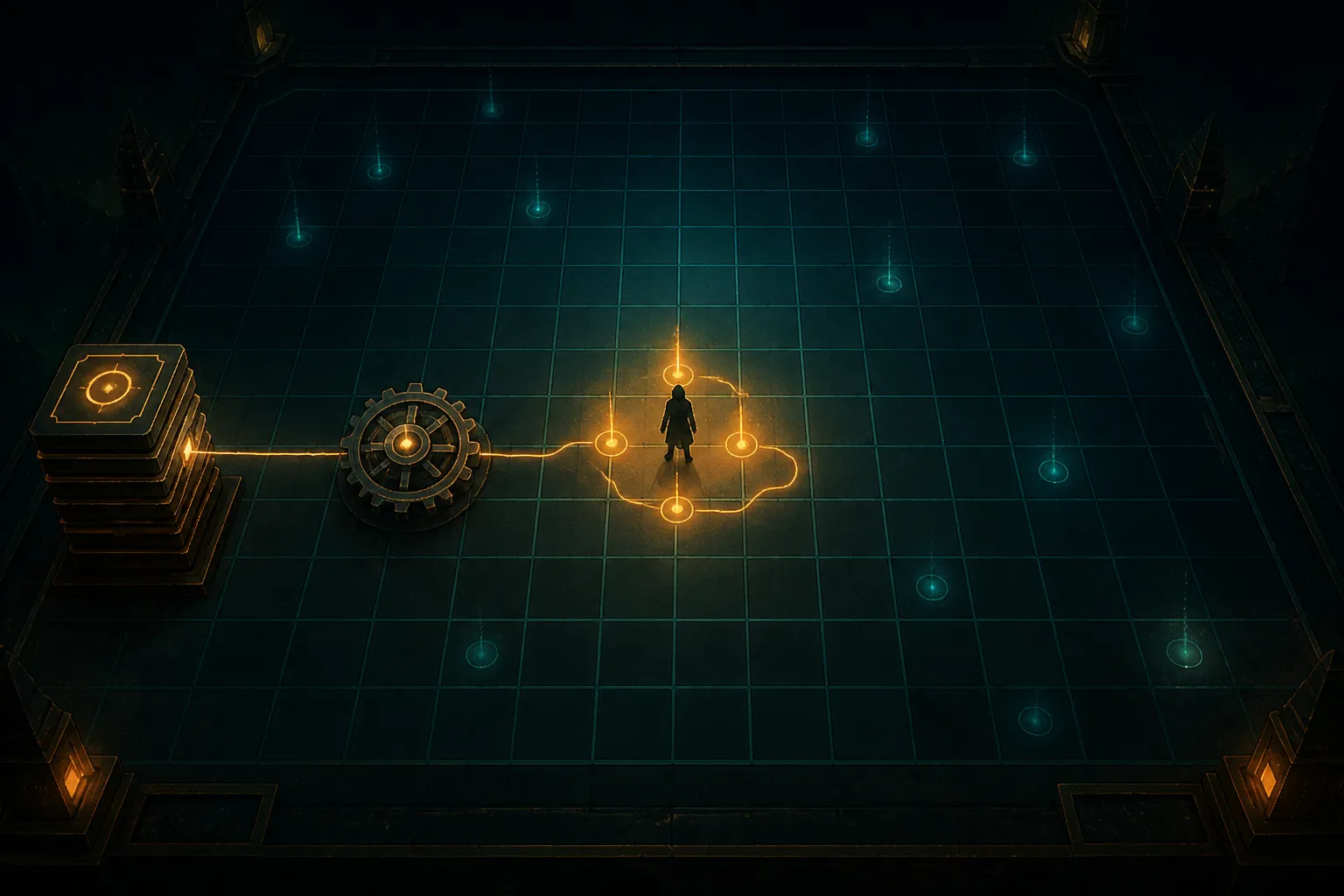
A power-up can make an arcade run louder without making its decisions deeper. The difference is what changes after it appears: does the player reconsider a route, accept a risk, or save the effect for a better moment? Or does the meter simply climb faster for a few seconds? The available sources do not document a particular game or any power-up behavior, so they cannot support a verdict about one. They do leave a useful review question: what evidence would show that a bonus is a choice rather than decoration?
A score increase is an outcome. A meaningful choice changes what the player considers doing next.

Measure the decision, not the flash
Power-ups often announce themselves through a vivid effect and an immediate reward. Those are easy to notice, but neither proves strategic weight. A score multiplier may feel exciting while leaving the best move unchanged. If the player would take the same route, attack the same target, and use the item at the same moment every time, the power-up may be a brief boost rather than a decision with consequences.
A stronger test is to compare the choices before and after acquisition. Does the item make a dangerous route worth attempting? Does it change which enemy or obstacle deserves attention? Can the player hold it, or does its timer start immediately? These questions trace the item through play. The pickup matters when it creates a new calculation, not merely when it supplies a larger number.
That distinction also keeps the review grounded. “It feels powerful” describes a sensation. “It made me take the exposed path because its shield covered the crossing” describes a decision and its cost. A useful review should report the latter, then say whether the result was repeatable across situations.
Look for a price, a clock, or a counter
Meaningful choices usually have pressure attached. A limited charge asks the player to choose when to spend it. A temporary effect puts timing on the table. A pickup placed in danger makes the reward compete with the cost of reaching it. Counterplay can matter too: an effect that changes how the player responds to threats offers more room for judgment than one that simply raises damage with no change in approach.
These are review tests, not claims about the games described by the available reading. The two linked pages, “Express Yourself(!): Creating a Ludic Language” and “Design 101: Balancing Games”, provide titles and navigation in the retrieved material, but no body text about power-ups. The second title points toward balance as a topic; its title alone cannot establish a balance principle or explain how a particular item works.
For a hands-on review, I would log the same details over several rounds: where the item appears, what the player gives up to collect or activate it, how long its effect lasts, and whether another option would have served better. Then I would compare outcomes. If the power-up is always taken and always used immediately, it may function as a routine reward. If its value shifts with position, remaining time, or current threat, it has a stronger case as a decision.
Separate choice from presentation
Arcade rounds are short, so a small change can matter. A brief speed effect might let a player cross a hazard before it closes. The same effect might also make careful steering harder. That tension could create a real choice if the player can decide when to trigger it and has enough information to judge the risk. Without such trade-offs, fast animation and a rising score can make a straightforward bonus seem more complex than it is.
The review should also watch for false choices. If one power-up is consistently better in every situation, the selection may be cosmetic. If options differ but the game never asks the player to choose between them, those differences may not shape a run. A choice needs both alternatives and a consequence for selecting one. In practice, that means noting missed opportunities as well as successful uses: what did the player not do because they spent the effect here?
Player evidence would help answer that question. Repeated sessions could show whether people save an item, spend it under pressure, or overlook it. A developer explanation or a detailed design source could clarify intended trade-offs. The available pages provide neither examples nor player data, so none of those behaviors can be asserted here.
Verdict: the question stays open
On the evidence available, the answer is not that power-ups are meaningful choices, or that they are only score boosts. The materials do not describe a power-up at all. Calling either outcome would turn a review into a guess, and the word “balance” in a source title cannot fill that gap.
The standard for a future verdict is concrete: identify the decision, name its cost, and show how the power-up changes the next action. If it changes route, timing, target, or risk in a way the player can control, it carries strategic weight. If it only adds points while leaving those decisions untouched, it is a temporary score boost. Until a game, item, and set of observed play sessions are in evidence, the fairest verdict is provisional.
Sources
- Express Yourself(!): Creating a Ludic Language
- Design 101: Balancing Games
- View of The Power-up Experience: A study of Power-ups in Games and their Effect on Player Experience
- https://vertexaisearch.cloud.google.com/grounding-api-redirect/AUZIYQEeKlftZsUyGxYZ1wvaDbicjiON55-fYjuFzmZ_WBbT4uTLJ25lwhXZafRu3zhUvRNbSWFyQ7U4FO8LY2SaupxzdImH0CMnEXYQsuErGCptOp6iklXiiHExJAv4oaxDrY-Pj1L7dtlEuqwUSYHJMtmBjaJh8odmsI2_ymldtZjIt6j7
- How to Power up Players with Upgrades
- Meaningful Choice in Games: Practical Guide & Case Studies

Jonah Bell is a house writer for GamesUnlimited who covers strategy games, simulation design, and player economies. He follows systems from tutorial to endgame, testing how patches reshape the choices players make.