Mobile players do not just need chat to exist. They need it to stay useful while their thumbs are busy and the game still has room to show what matters. Discord’s easier-to-pin video overlay points toward a better handoff between play and conversation, but an overlay that works on one kind of screen does not erase the limits of another. The useful test is what each approach lets a player do, and what it makes them give up.
- Screen cost: Does chat cover important play or squeeze the game into a smaller view?
- Speed: Can a player bring up or dismiss communication without losing control?
- Reach: Does the same social group follow players across games and devices?
- Access: Can players use the communication layer in ways that fit their needs, including when voice is not practical?
The core tension is a budget, not a toggle
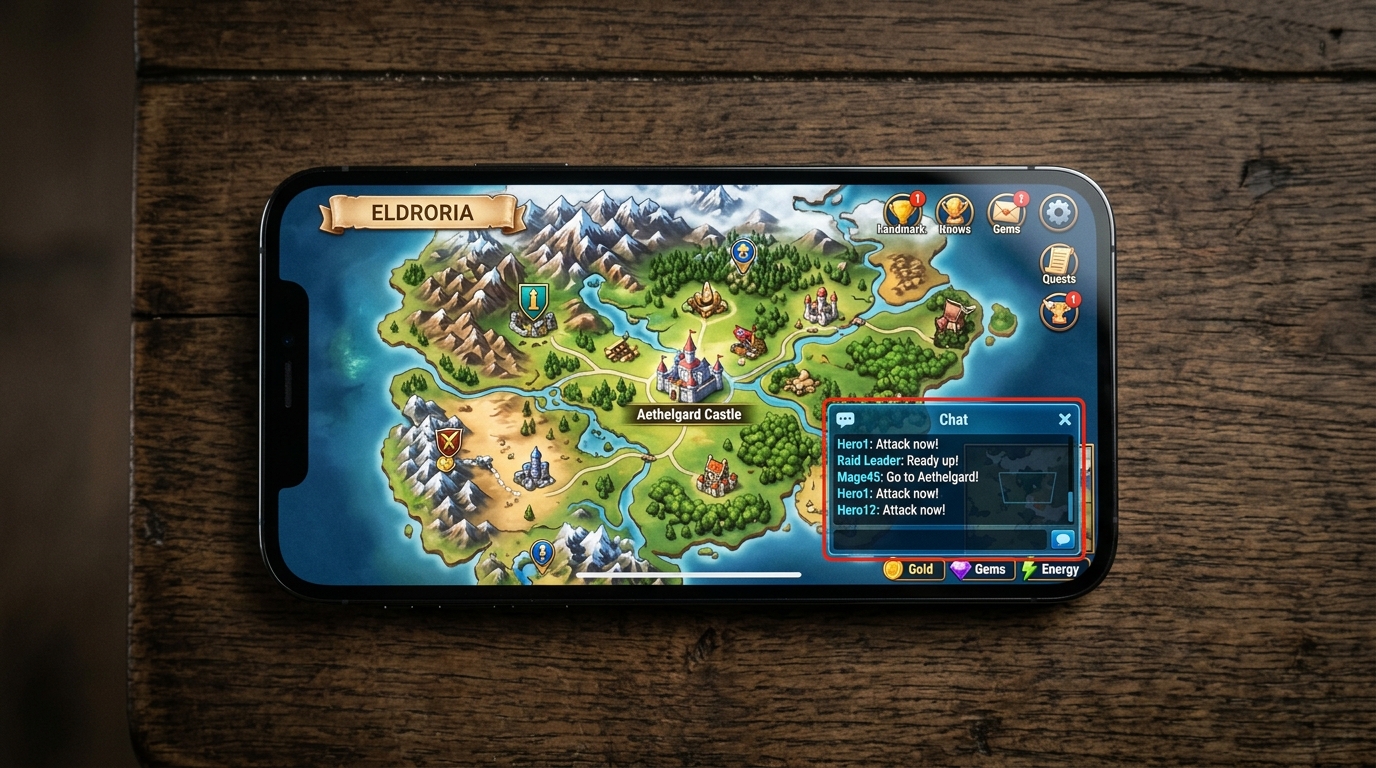
A phone display is a fixed budget. Every persistent tile takes pixels from the game, and every tap used to open a chat panel is a moment when a player may stop steering, aiming, or reading the field. A PC player can often move a chat window to another monitor. On a phone, communication and play compete for the same surface.
The cost changes with the game. In a turn-based match, a player may have time to check a message between decisions. In a fast cooperative encounter, a callout that arrives after the moment has passed is little better than no callout. Voice can reduce the need to look away, but it does not suit every player or every setting. Text and video add different demands: text needs attention, while video needs both screen area and a reason to remain visible.
This is why “keep chat within reach” is not one design problem. It is a chain of small costs: open the layer, find the message, understand it, then return attention to the game. A good interface shortens that chain. A bad one moves the interruption from one button to another.
Discord improves the overlay step, not the whole chain
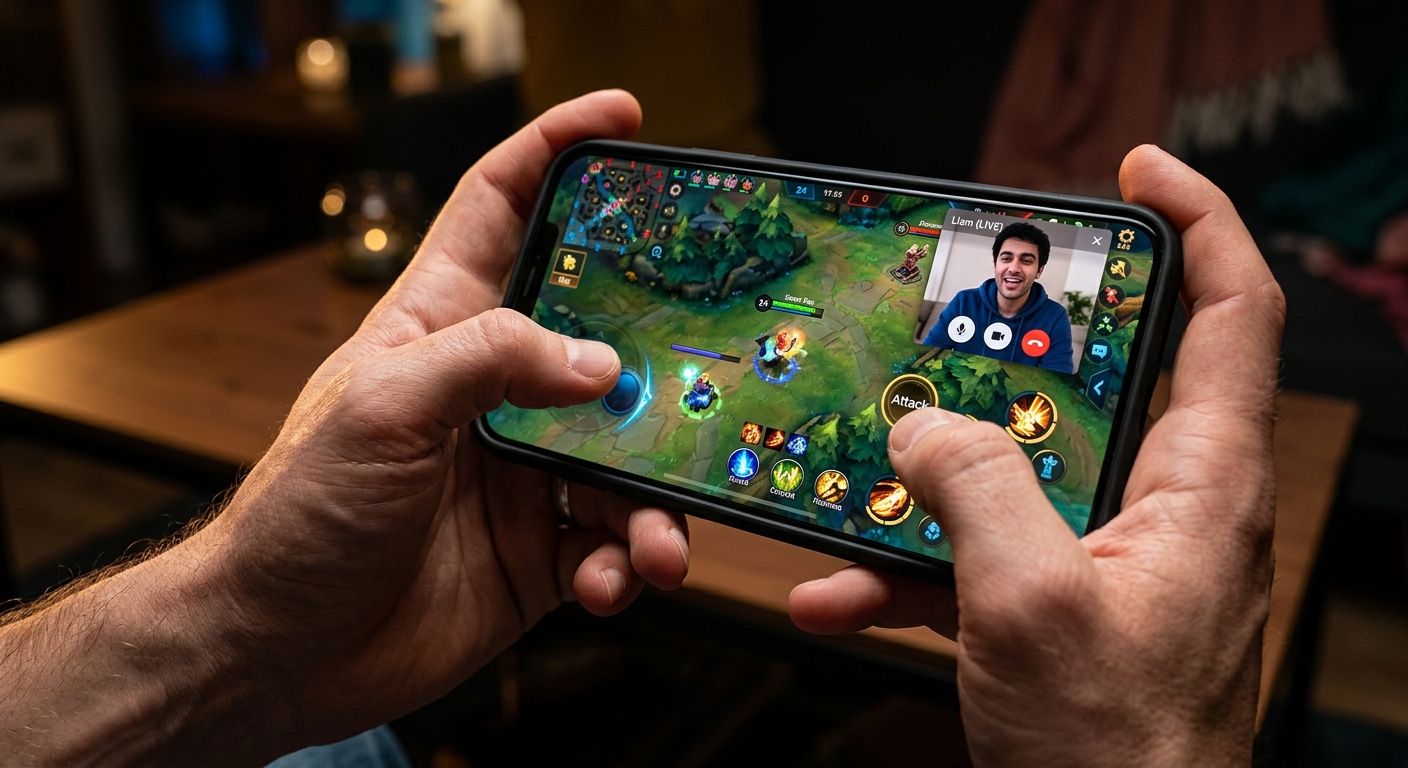
In March 2025, Gizmodo reported that Discord had made pinning a video chat window in its Game Overlay easier. The practical change is about friction. If players can anchor a small video tile with less fuss, they may be more willing to keep friends visible during a session instead of treating video as a setup task they will skip. Gizmodo’s report on the update describes a more convenient in-game overlay.
That is a meaningful quality-of-life gain, but it is not evidence that every phone can now host the same persistent tile over every game. The report concerns Discord’s Game Overlay, and the larger lesson is about interface design: pinning should be a short, predictable action, not a detour through menus. Phone operating systems and games also decide what can appear over play and how much control an app receives. A smoother gesture cannot guarantee compatibility or create extra screen space.
There is a second limit. Pinning solves visibility, not attention. A video tile can let friends react to a moment, but it may also cover a minimap, a status bar, or the edge of a target. Players need control over placement, size, and when the overlay retreats. If those controls are awkward, the tile becomes a permanent tax rather than a useful window.
System-level chat trades portability for integration
A platform-native communication layer takes a different route. Instead of asking each game to make room for a separate service, the operating system or device layer provides a common place for communication. GameChat is one example of that system-level approach. Its documented feature set includes accessibility considerations, a reminder that communication tools need to work for people who cannot or do not want to rely on voice alone. GameChat’s feature overview offers a view of that platform-centered model.
Integration can reduce the number of steps between a game and a conversation. The platform can define how the interface opens, how it behaves across supported games, and which accessibility options are available. The tradeoff is reach. A system feature depends on the devices and software that support it, while players’ existing friend groups may live in a separate service. A tidy built-in layer is less useful if the people a player wants to talk to cannot join it.
That makes platform chat strongest within its own ecosystem. It can provide a more consistent interaction than a collection of game-specific menus, but it cannot automatically unify every account, title, and device. For players who switch between a phone, a handheld console, and a PC, the boundary between systems can become another source of friction.
Game-owned communication avoids some overlay costs
Communication designed into a game has one advantage outside services cannot easily match: the developers know what the player needs to see at each moment. A social panel can be positioned around the game’s own controls, and its behavior can change between a quiet menu and a busy encounter. That makes native design a useful model for reducing screen conflict, even when the feature is not a general-purpose chat service.
My Talking Tom Friends 2 is a reminder that mobile games can build their experiences around their own interface and social context, rather than assuming players will bring a separate overlay. It is not a substitute for a portable group chat. A game-owned feature usually serves that game, and players who move to another title may have to start over in a different social space. The design benefit is local; the network benefit does not travel with it. The game’s overview helps distinguish a title-specific experience from a shared communication layer.
For developers, the strongest pattern is to treat communication as part of the screen plan early. That means deciding which moments need text, which can use voice, and which can wait until a break. It also means testing on the smallest supported display, not only on a large phone or tablet. A chat panel that looks harmless in a menu can obscure the one indicator a player needs in a live match.
Scorecard: useful progress, no universal pass
The four tests point to different winners. Third-party overlays have the broadest chance of following a friend group across games, while platform features can make access and controls feel more consistent inside a supported ecosystem. Game-owned communication can fit a particular title closely, but its benefits tend to stop at the title boundary.
On a phone, screen cost remains the hardest score to improve. A smaller tile helps only when it stays legible and avoids essential controls. Hiding the overlay saves space, but then players must reopen it and pay the attention cost again. The right tradeoff depends on the game’s pace, the player’s communication needs, and whether a conversation can pause during an active sequence.
So can mobile players keep chat within reach without losing the game? Sometimes, for a specific game and setup. Discord’s overlay update makes one part of the process easier, platform-native tools show how integration can help, and game-authored interfaces can avoid some collisions. None removes the central constraint: on a phone, chat and play still share the same screen. The best current solution is the one that gives players a fast way to communicate, a fast way to reclaim the view, and no surprise about what gets covered.
Sources

Jonah Bell is a house writer for GamesUnlimited who covers strategy games, simulation design, and player economies. He follows systems from tutorial to endgame, testing how patches reshape the choices players make.