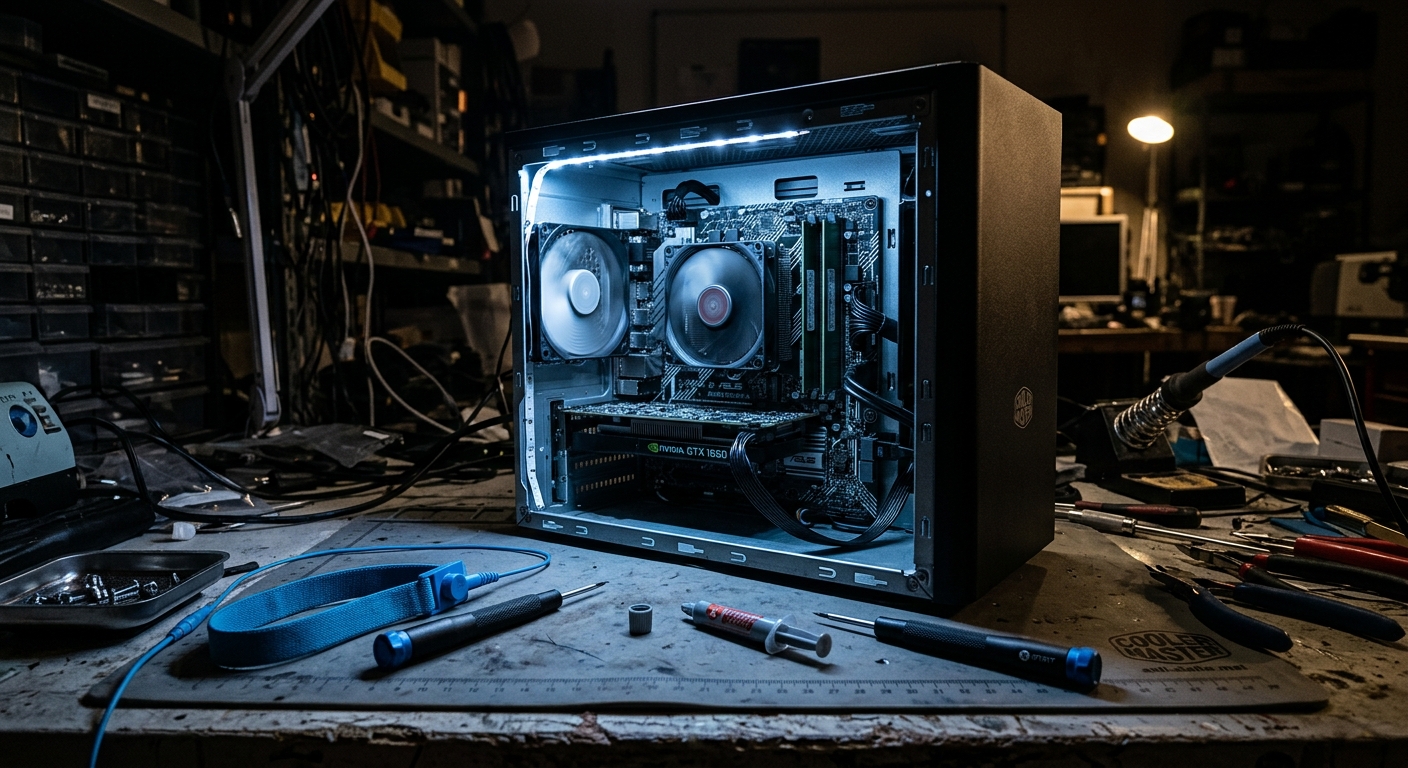
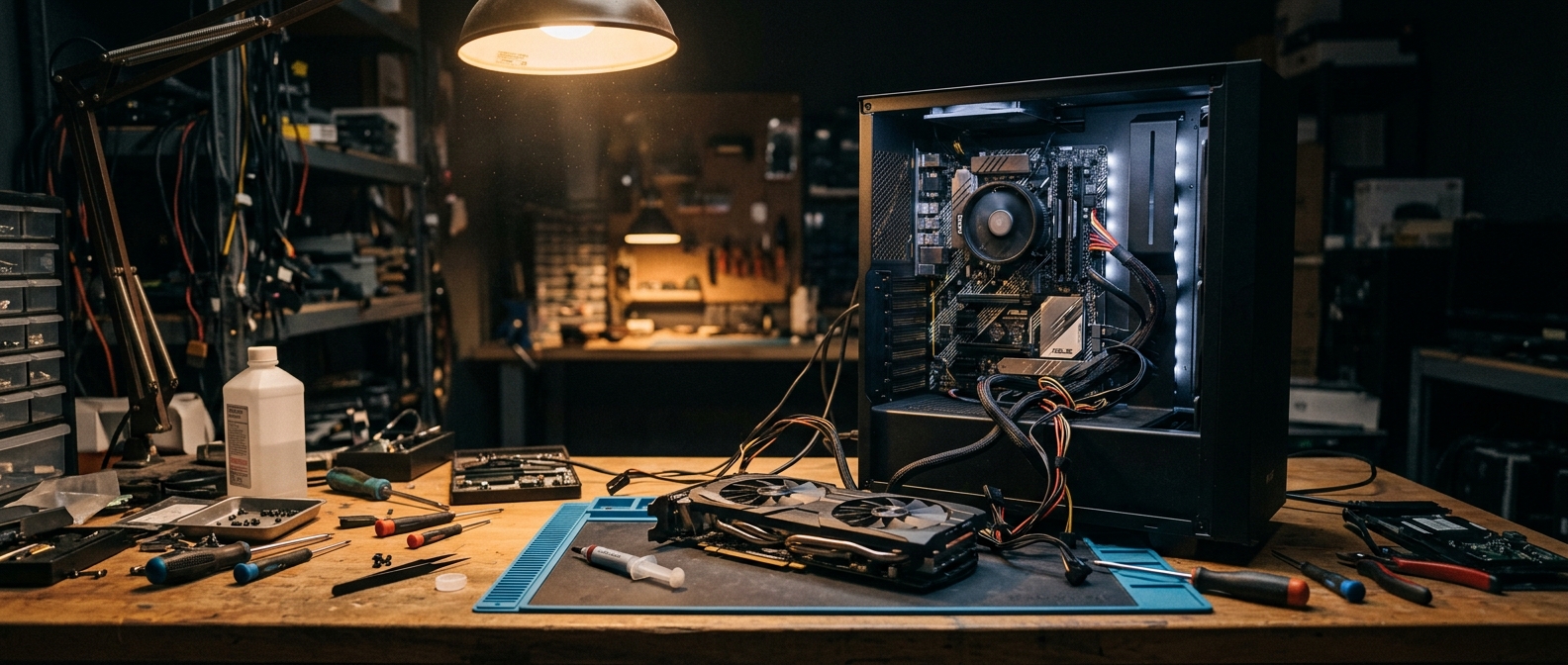
There is a machine on the bench. The fan spins. Nothing posts. The customer says it worked fine yesterday, which is what every customer says, and which is almost never the full story. PC Building Simulator 2 puts you in exactly this situation, repeatedly, inside a virtual repair shop where the incoming caseload escalates from simple thermal paste replacements to multi-symptom fault-finding that would not embarrass a real diagnostic checklist. What surprises you, once you stop expecting a building game and start accepting a diagnostic one, is how much the thinking transfers.
The Shop Floor as a Kind of Classroom
The game's career mode delivers customer machines through an inbox. Early jobs are forgiving: swap a failed drive, reseat a memory stick, clear a filter that has been accumulating dust since a previous administration. Later jobs layer symptoms until the original complaint is almost a decoy. A machine that "runs hot" might have a misconfigured fan curve, or a dried thermal interface, or a cooler mounted with uneven pressure, or some combination of all three. The game does not tell you which until you work through the evidence.
What makes this structure quietly effective as instruction is the consequence model. Failure is reversible and annotated. If you replace the wrong component, the game says so, and you open the case again. This is nothing like the consequences on a real bench, where a wrong diagnosis costs a customer money and costs you credibility, but it is an excellent way to drill the reasoning habit before those stakes exist. The game functions less like an exam and more like a patient senior technician who lets you make the call and then tells you what you missed.
I spent two decades diagnosing arcade cabinets in environments where the floor was sticky and the ambient noise was a solid wall of sound effects and quarters hitting coin doors. Diagnostic thinking in that context was essentially the same as what PC Building Simulator 2 models: symptom, hypothesis, test, revision. The hardware is different. The loop is not.
Touching Without Touching: The Haptics of Simulation
Real PC building is physical in ways that matter. The click of a CPU retention lever has a particular authority to it. A PCIe slot has resistance, and then a snap, and the absence of that snap tells you something before you even look. A case panel that does not quite fit tells you the motherboard standoffs are in the wrong position. None of this is available to a simulator, and a simulator that pretends otherwise is a simulator that will mislead you.
PC Building Simulator 2 does not pretend. Instead it makes a different trade. Each component has a distinct audio profile on installation and removal, so that what would be tactile feedback in a real build becomes audio feedback in a virtual one. Muscle memory becomes something closer to audio memory. This is a lesser substitute in some respects and a different tool in others, because it forces the player to process information consciously rather than reflexively, which is actually useful for beginners who have not yet built the physical intuition.
The camera and part-rotation systems are engineered to make a virtual case feel cramped. Routing a cable behind a mid-tower motherboard tray in this game requires the same spatial negotiation that anyone who has done it physically will recognize, the angle you need, the components in the way, the point at which you accept a slightly inelegant path rather than the clean one. The simulation cannot reproduce the sensation, but it reproduces the problem, which is most of what a training environment needs to do.
Licensed Hardware and the Question of Accuracy
The sequel expanded its roster of licensed components from real manufacturers, and this is a more significant design choice than it first appears. A GPU in this game corresponds to actual thermal design power figures and slot requirements. A power supply has a real wattage ceiling. A motherboard has genuine socket compatibility constraints. When a build is bottlenecked or a PSU undersized, the numbers that explain why are the same numbers a player would find cross-referencing a spec sheet in the real world.
This collapses the distance between simulation and practice in a specific way. A player who learns here that a particular GPU draws more power than its predecessor can carry that information to a real purchasing decision. The game becomes a glossary for a hardware culture that communicates almost entirely in model numbers and generational shorthand, and fluency in that language has practical value outside the simulation.
The limitation is temporal. A simulator that accurately models a hardware generation will age as that generation recedes. The question of whether a simulation should be updated the way a textbook is revised is one the developers will eventually have to answer more explicitly. For now, the foundational reasoning, how to match components, how to identify a bottleneck, how to read a power budget, remains accurate even as specific model numbers drift into the past.
Diagnosis as Narrative Engine
Most games deliver story through cutscenes or dialogue. This one delivers it through the condition of a machine. A rig caked in dust tells you something about the person who owns it and how they live with technology. A component that has been deliberately set to incorrect settings hints at something the customer's complaint did not mention. The machine itself is the text, and diagnosis is the reading of it.
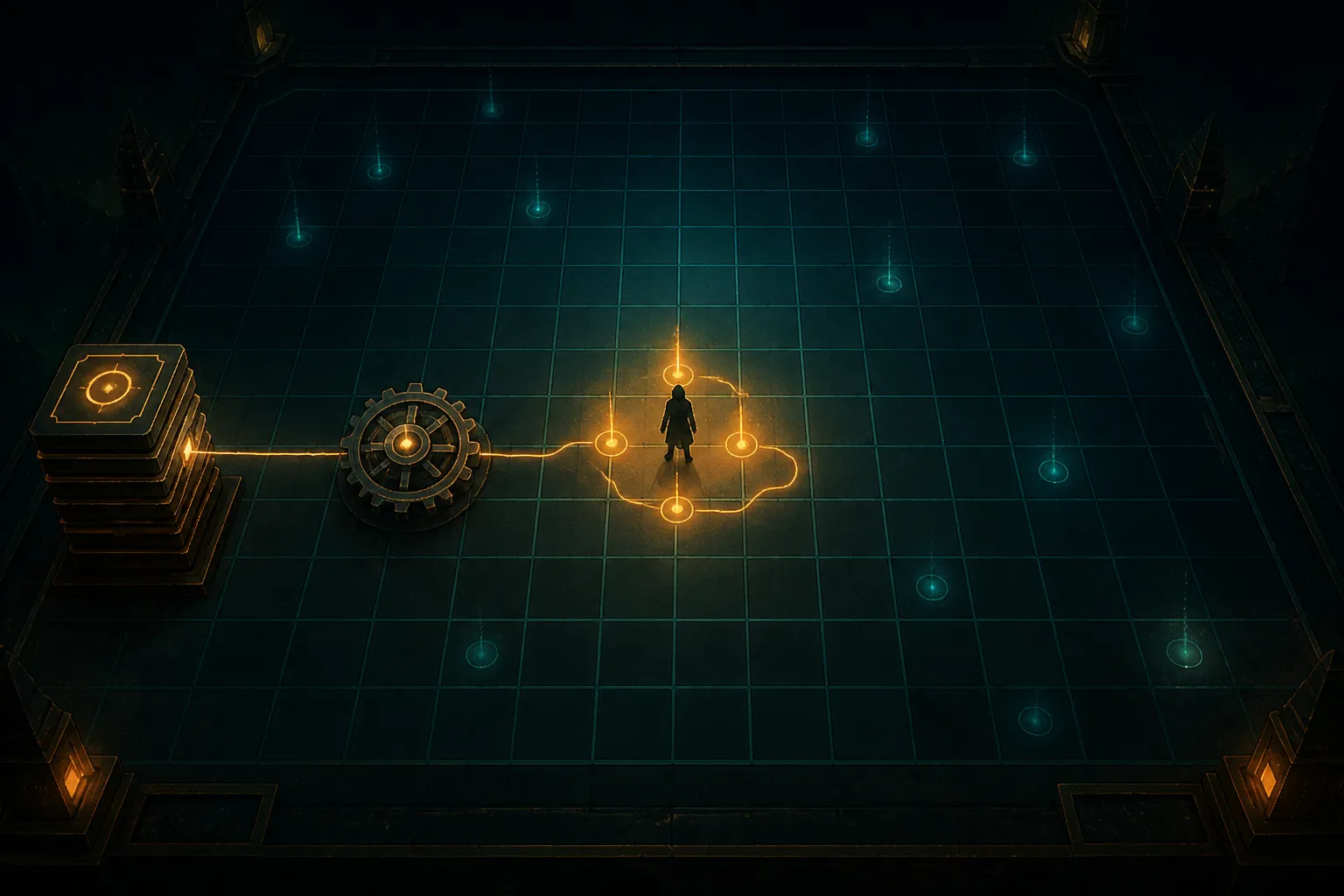
The fault-finding loop has the structure of a short story. The machine arrives symptomatic. You interrogate it. The repair succeeds, or it exposes a deeper problem that the original complaint was only pointing toward. This is not so different from the classic arcade loop, problem, obstacle, resolution, but it runs at a much slower cadence and rewards systematic elimination over reflexes. The game sits in a space adjacent to puzzle games without quite being one, because the solution is always physically plausible rather than constructed for elegance.
The quiet art in question is exactly this disposition: the ability to sit with an unresponsive machine, resist the urge to start swapping components at random, and trust that the answer is already in the evidence if you read it carefully. The simulator trains this without ever announcing that training is what it is doing. That is the most effective kind of instruction, and it is rarer than it should be in games that call themselves educational.
What the Simulator Cannot Teach
No simulation has yet reproduced the specific dread of a new build producing a grinding noise on first power-on. The sound is bad before you even identify its source. Nor has any simulation reproduced the relief when a machine that refused to post suddenly does so after a single reseating of a memory stick, a relief that is disproportionate to the effort and entirely reasonable given what the alternative would have been. These moments carry emotional weight the game can only approximate, and the approximation is thinner than the real thing.
The simulator also skips supply chain anxiety entirely. A real build can stall for weeks on a GPU that is unavailable at any reasonable price, or restart completely when a part ships damaged. The inbox system in the game delivers clean, solvable requests with components that are always in stock. This is a reasonable design choice for a game and a significant omission for a training tool, since supply chain navigation is a genuine skill in real hardware work.
There is also a social dimension the game flattens. The client who is certain the problem is software when it is definitively hardware. The negotiation over whether a repair is worth the cost of the part it requires. The customer who returns a machine a week later with the same complaint and a different story. These interactions are part of real repair work, and an inbox of pre-digested requests cannot capture them. Acknowledging this is not a complaint about the game so much as a clarification of its scope.
PC Building Simulator 2 is an on-ramp. It is a controlled environment where the reasoning habits of a competent technician can be practiced before the stakes become real and the machine on the bench belongs to someone who needs it back by Thursday. On those terms, with that scope clearly in view, it succeeds with more elegance than the genre usually manages.
Sources

Marguerite Osei is a house writer for GamesUnlimited covering classic arcade cabinets, pinball, and the hardware that keeps them running. She spent two decades repairing machines in family arcades before she started writing about them. Her reviews weigh how a game plays against how well it holds up to a thousand quarters.