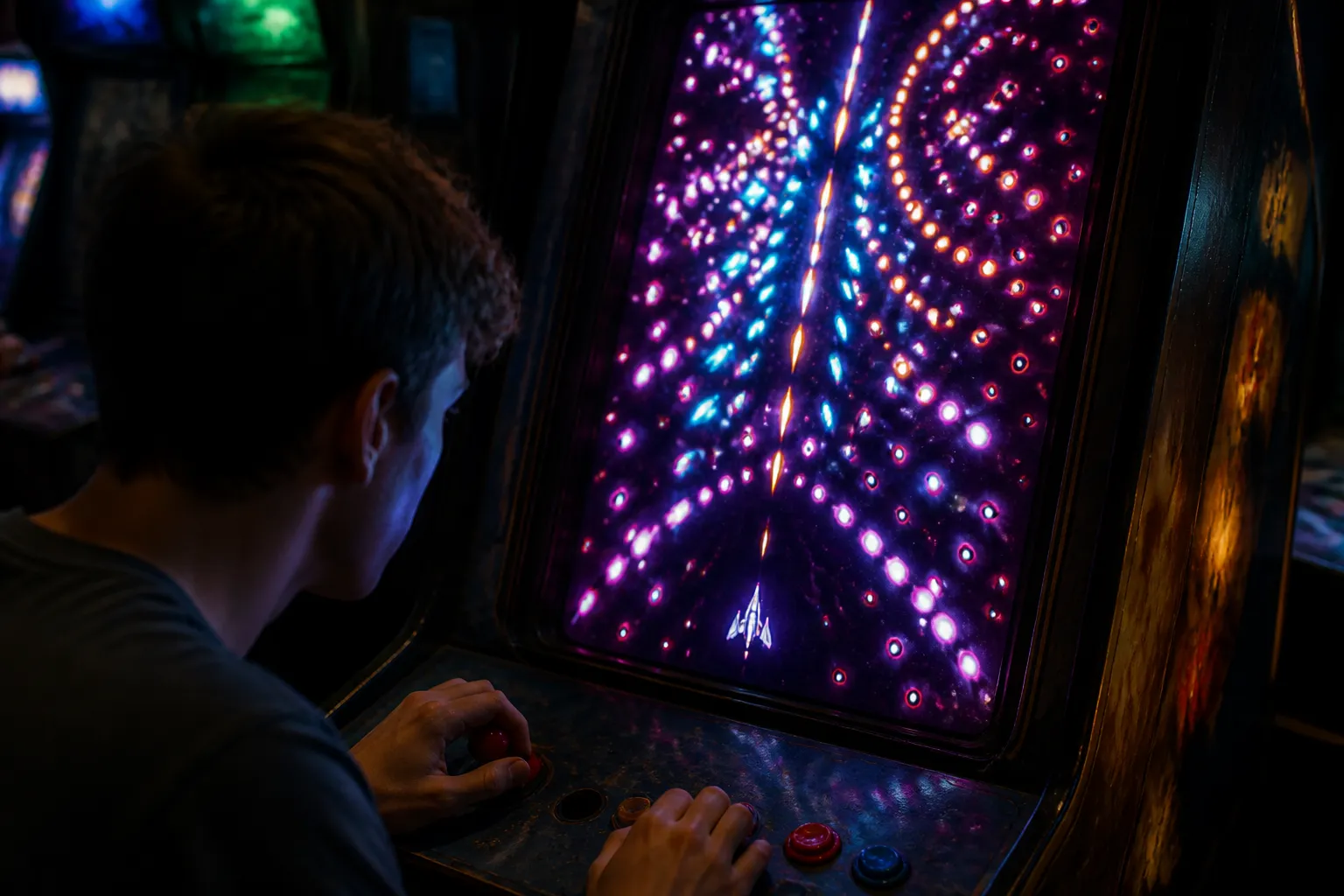
Dense bullet patterns look like noise at first. That is the honest first impression, and the genre expects it. Nothing is broken when the screen fills up.
What you are walking into
A bullet hell is a 2D action game where you dodge intricate patterns of bullets while shooting enemies. The Dodonpachi and Touhou series are the names people reach for first. Cave's Dodonpachi, from 1997, is described as the game that solidified the style as its own thing.
Sometimes hundreds of bullets sit on screen at once. The first screen reads as noise. Your job in the first minutes is not to win. It is to sort the bullets that matter from the ones that only add pressure.
One correction before going on. A bullet hell is not simply a harder shmup. The source says arcade shmups of every kind are intense. The difference is the style of play, with dense patterns instead of raw speed or a parade of hazards.
Why the first minutes feel different
Bullets here are slower than in a traditional shooter, and there are more of them. They also linger. In an old-school shmup, a bullet that gets past you stops being your problem. In a bullet hell it can hang around and become part of a maze. That is why the game gives you time to read the screen.
Then there is your ship. The hitbox can be very small, sometimes a single pixel. The sprite you see is larger than the part that can be hit. That extra room means gaps that look too narrow can still be survivable. Watch the center of the ship, not the wings.
Expect pressure from every side, then relief when you live through it. Early deaths are part of the rhythm. Treat them as reading time.
Here are three notes for the first ten minutes, kept short:
- Treat the screen as a maze, not a crowd. Look for the lane, not every bullet.
- Trust the small hitbox, but test it in safe spots before you bet a life on it. This is a practical tip, not something the sources cover.
- Expect to die early. Count it as practice.

How to read a pattern
Designers can vary the shape, size, speed and colour of bullets, so the screen is not one uniform wall. That variety is useful once you slow down. A big, bright bullet tends to grab your eye first, but a small fast one may be the real threat to your lane. Try sorting by speed before anything else, then by where each bullet is heading.
A simple way to practise is to stop chasing the whole screen. Pick one stream of bullets and follow it until it leaves. Then pick the next. Because bullets linger and are slower than in classic shooters, a pattern often repeats its shape, and you can spot the shape before the gaps open. Start with small, short moves. Large swings of the ship tend to carry you into the next stream.
How to check whether the style suits you
The source calls bullet hell a flavour that is not for everyone. There is a real divide between its fans and the fans of traditional shmups. Both camps are happy. They want different evenings.
A fair test is simple. Ask what you enjoy more. Constant attention and interesting movement, or faster pacing with walls, traps and enemies that behave in varied ways. The first points to bullet hell. The second points back to the classics.
If the first few rounds are pure stress and you take no pleasure in reading a pattern, try a different shmup. That says something about fit. It says nothing about you.
- Do you like reading a pattern more than reacting to a surprise?
- Does surviving a wall of bullets feel like relief, or like luck?
- Do you want constant attention and interesting movement, or faster pacing and varied enemies?
What the sources leave open
Be wary of anyone who claims a precise ten-minute plan from this material. The sources do not describe the opening of any specific game. They give no concrete survival tactics. One of them held only site navigation, and another cut off after its introduction.
They also skip controls, difficulty settings, scoring and beginner-friendly titles. Nor do they say how a browser version handles hitboxes, bullet speed or density compared with an arcade board. Those could differ, so check before assuming the dot behaves the same way.
Take the above as orientation, not a manual. Read the pattern, watch the small hitbox, and expect to lose a few lives.
Sources

Marguerite Osei is a house writer for GamesUnlimited covering classic arcade cabinets, pinball, and the hardware that keeps them running. She spent two decades repairing machines in family arcades before she started writing about them. Her reviews weigh how a game plays against how well it holds up to a thousand quarters.