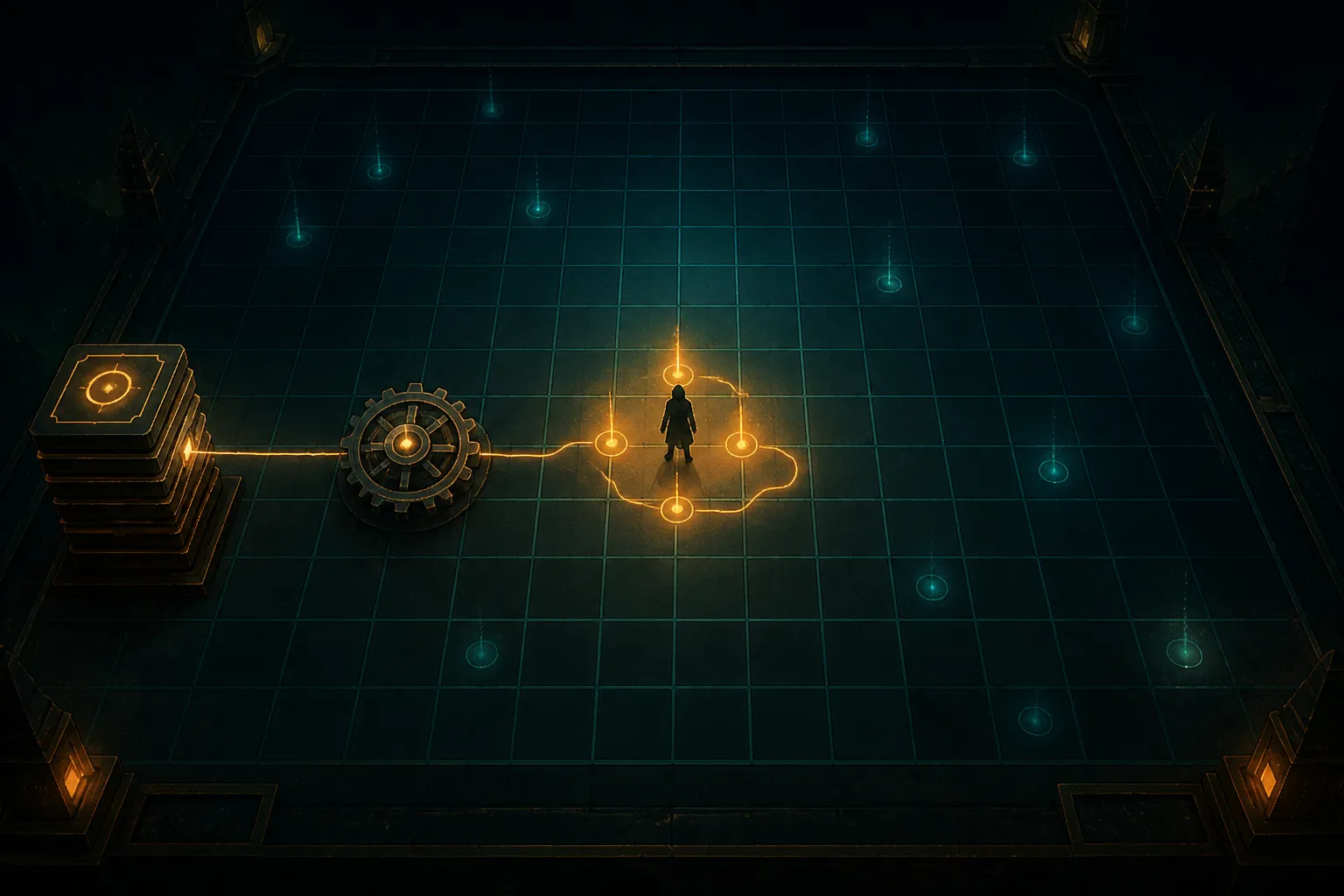
Spawn cadence is often treated as a rate: how many enemies arrive, and how often. For difficulty, the more useful measure is the time a player has to act between arrivals. That interval can be a recovery window for repositioning, reading the field, or restoring a resource. Change it, and the same threat can feel manageable or relentless.
This makes cadence a pressure budget. Every new enemy spends some of the player's attention and room to maneuver. If arrivals keep spending faster than the player can recover, pressure accumulates. If the budget goes untouched for too long, tension can fade. The design problem is to place the quiet moments where they preserve a choice, not merely to insert pauses on a timer.
The available source describes pacing as a rhythm of challenge, action, and downtime, with intensity rising and falling rather than staying at one level. Its clearest example is Left 4 Dead's AI Director, which reportedly adjusted zombie hordes in response to player stress and success. That gives a useful model for thinking about cadence, but not a ready-made schedule: the source offers no intervals, thresholds, or test results to copy.
So the practical question is not whether adaptive spawning is better in every round. It is what the player can do during a gap, what evidence suggests the gap is too short or too long, and how the next arrival changes the round's pressure.
Cadence sets the cost of each threat
A spawn adds more than an enemy to the field. It also asks the player to spend attention on a new position, movement pattern, or immediate danger. When another threat arrives before the player has responded to the last one, the round compounds those costs. A player may still be moving and firing, but have no time to make a deliberate decision.
That is why a raw enemy count tells only part of the difficulty story. The interval between arrivals affects whether the player can clear a threat, change position, and notice what is coming next. A long interval can create room for those actions. A short one can turn them into competing demands. This is a design inference from the role of pacing, not a measured result in the source.
Recovery does not have to mean safety or inactivity. A window can let the player move toward a better position while still tracking a hazard, or use a limited resource before the next wave. Its value comes from restoring some agency. If nothing useful can be done during the gap, it may read as dead time. If every gap still demands urgent action, the round has no effective recovery at all.
Adaptive pacing changes the schedule
Dynamic Difficulty Adjustment, or DDA, lets a game respond to performance in real time. The source describes a simple range of responses: ease pressure when a player struggles, or add challenge when a player excels. Spawn timing is one possible control because the system can change how frequently threats arrive without changing the basic rules of combat.
In the source's account, Left 4 Dead's AI Director monitored player stress and success, using signals such as health, progress, and accuracy to decide when to add enemies or hold them back. The stated aim was to avoid two bad states: constant combat that becomes fatiguing, and long quiet stretches that become boring. The Director's cadence therefore follows the changing state of the group instead of relying only on a fixed clock.
That example describes a control loop, not a universal formula. A designer would need to choose which player signals matter, how they relate to pressure, and how quickly the system responds. The source provides no thresholds or evidence about how those decisions perform in a particular game. It also does not establish that changing spawn timing is always preferable to adjusting another part of the challenge.
Test the window, not just the wave
For a round-based game, a useful test begins with a trace of the round: when threats arrive, what the player is doing, and what resources remain. The aim is to connect an arrival to its consequence. Did the player have time to move or recover? Did the next threat interrupt a choice already in progress? Did a quiet stretch give the player room to prepare, or did it drain all urgency?
Compare a fixed schedule with an adaptive schedule under the same basic encounter conditions. Keep track of the changes a player can actually feel, such as repeated interruptions or unusually long idle stretches. This comparison is a proposed testing method, not a result reported by the source. The source gives no playtest outcomes and no validated way to score a recovery window.
It is also worth separating cadence from other changes. If one version both spaces out enemies and weakens them, a better outcome cannot be attributed to timing alone. A controlled comparison can change one lever at a time, then test whether the effect holds across different player performance. That is especially important for adaptive systems, where a response to one stretch of play can alter the next.
The verdict depends on what the gap restores
The source supports a direction, not a tuning recipe. It identifies pacing as a balance between action and downtime, and points to the AI Director as an example of adjusting pressure in response to players. It does not tell designers how many seconds a recovery window should last, what threshold should trigger a pause, or how much adaptation improves outcomes.
For a browser or arcade round, the consequence is straightforward: treat adaptive cadence as a hypothesis to test. Start by deciding what a useful gap lets the player do. Then compare fixed and responsive schedules and observe whether those actions become possible without making the round feel empty. A spawn interval is not a difficulty setting by itself. Its value is measured in the choices it gives back before the next threat arrives.
Sources
- AI-Driven Adaptive Pacing Across Gaming, Education, Fitness, Storytelling, and Business Workflows
- Threat Assessment Algorithms - recited
- Dynamic Difficulty Adjustment
- Risk of Rain - Wikipedia
- Dynamic Difficulty Adjustment in Games: Concepts, Techniques, and Applications | IntechOpen
- Mike Booth - Wikipedia

Jonah Bell is a house writer for GamesUnlimited who covers strategy games, simulation design, and player economies. He follows systems from tutorial to endgame, testing how patches reshape the choices players make.