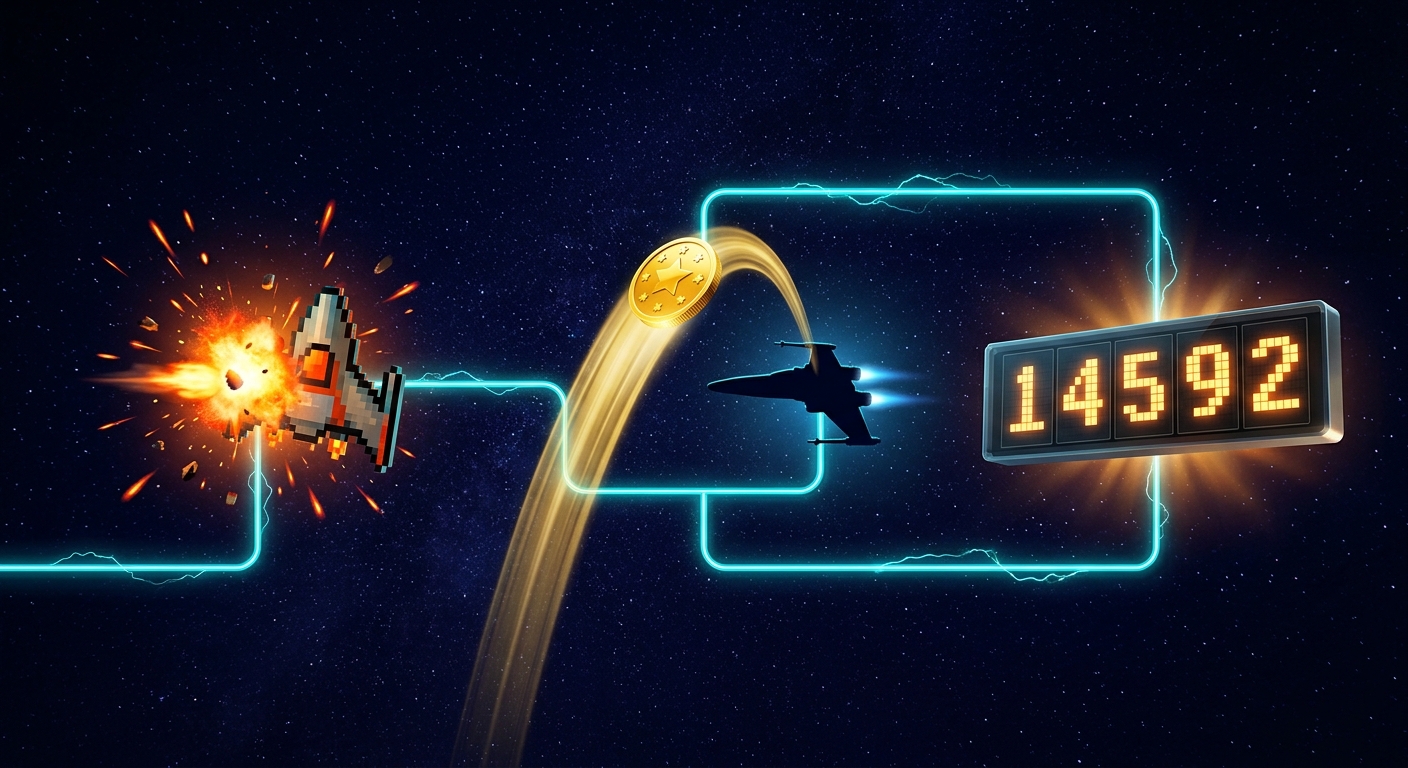
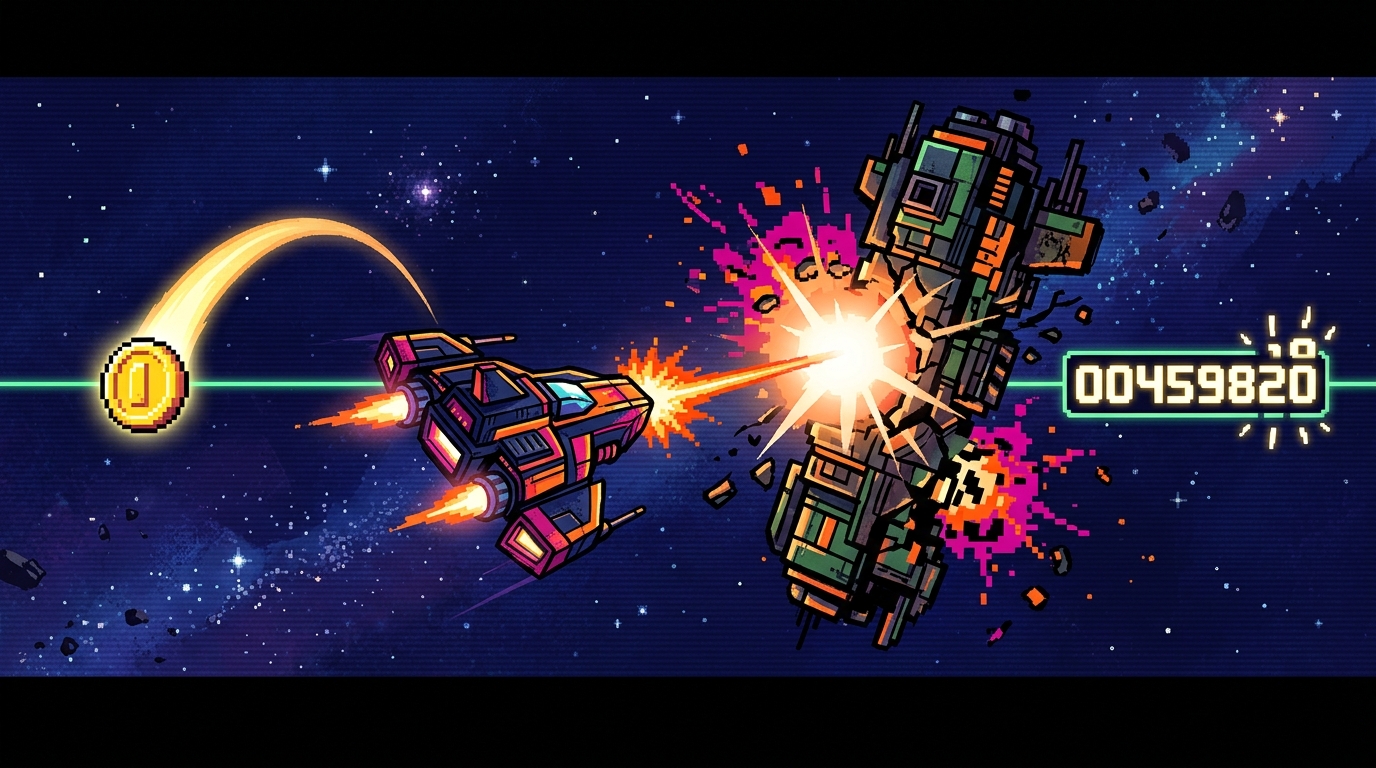
One coin drops. A ship slides between two bullets. The player taps fire, and a small orange burst snaps against an enemy hull. “Did I get it?” The answer arrives before the next shot: a crisp crack, a blink of recoil, and a score tick. In an arcade game, that instant is a contract. The player acts; the game answers.
- Hit: Did the target react at the moment of contact?
- Pickup: Did the object visibly travel into the player’s possession?
- Point: Did the score confirm the value of the action?
- If one signal is delayed or missing, can the player still tell what happened?
- Does the confirmation leave the next threat visible?
The split-second contract between game and player
That little chain is easy to take for granted until one link slips. A shot appears to connect, but the enemy keeps moving. The sound arrives late. The points appear after the player has already turned away. Now the player is doing detective work in the middle of a dodge: Was the input ignored? Was the target armored? Did the game count the hit?
Fast action leaves little room for that uncertainty. A useful response ties the player’s input to a visible, audible consequence quickly enough that both feel like parts of the same event. A hit flash, a short pause in the enemy’s movement, and a sharp impact sound can reinforce one another. If they disagree, the player has to guess which channel to trust.
That is why feedback is more than decoration. It teaches cause and effect. A discussion of negative feedback in game design points toward an important distinction: a signal can help a player understand an outcome, or add more confusion to it. The difference matters most when the screen is already busy and the next decision cannot wait.
Hits and hurts need different voices
A good hit feels good, but its celebration has a job to do. The impact can punch through, then get out of the way. A brief burst of particles, a compact hit-stop, or a low thud can say “contact” without covering the projectile approaching from the right. The signal is satisfying because it is precise, not because it fills the whole screen.
Damage asks for a different treatment. A red flash that hides the playfield may announce a mistake while causing the player to miss the next attack. That is feedback adding a second problem to the first. A short hurt sound or a controlled edge flash can register the damage and preserve the center of the screen, where the player needs to look.
Think of the cabinet as keeping two separate accounts. Success gets a clean, sometimes rising note; damage gets a blunt warning. They should be distinct enough that the player can sort them without stopping to inspect the display. The distinction need not be loud. A small change in pitch, duration, or screen position can carry more information than a full-screen explosion.
Pickups and points teach a visual grammar
A coin that pops loose and arcs toward the character does more than look lively. The movement says the enemy dropped something, and the destination says it now belongs to the player. A pickup that vanishes in a crowded effect without any sound or score change can leave a nagging question: did it count?
Floating numbers compress several answers into one glance. “+100” confirms that something happened, places the result near its source, and assigns a value. Its design can help distinguish a routine reward from a major one. A small, quick-fading number feels incidental. A larger gold number that hangs for a beat asks for attention. If every point value gets the same treatment, the screen loses that useful hierarchy.
Consistency is the key. If blue pickups always restore energy and gold bursts always mark a high-value target, players can recognize those cues while keeping their eyes on the next hazard. If the colors shift without a reason, or score text overlaps the player sprite, the visual grammar becomes another thing to decode. The best reward effect leaves the player with one quick thought: “That counted,” and enough screen space to act again.
Sound reaches the player on another route
In a crowded scene, the eye may be tracking a moving target while the ear catches the result of a shot. Give events distinct sonic identities: a dry crack for an ordinary hit, a metallic ring for a blocked strike, a brighter ping for a collectible. The player can learn that vocabulary over repeated attempts, then hear a change without moving their gaze.
Duration and pitch add another layer. A short, low impact can mark a basic collision. A higher note that climbs can signal a critical hit or a combo step. There is no universal sound that means “big reward.” What matters is a stable relationship between the sound and the event, so the player learns what the signal promises.
Mixing can make that promise clearer. If explosions and enemy effects swell at the exact instant the player lands a hit, the confirmation may disappear. Pulling back other sounds for a fraction of a second gives the player’s action room to speak. It is a tiny edit in the soundscape, but it changes what the player can read in the middle of a run.
Let feedback respond to the run
A fixed signal can work beautifully at one pace and feel flat at another. A player learning a timing window may need a clear cue that makes a near miss understandable. Someone chaining hits confidently may not need the same explanation. Research into dynamic feedback in a VR pointing game explores how feedback can adjust around a user’s performance and support self-regulation. The setting differs from an arcade cabinet, but the design question travels: what cue helps this player read the action right now?
In an arcade action game, that does not have to mean quietly changing the rules. A game could vary the emphasis of a hit-stop or score flourish during a streak, while keeping the underlying collision consistent. A stronger confirmation on the third hit in a chain can mark the rhythm without changing which attacks connect. The signal rewards a pattern and makes the pattern easier to feel.
Run the scene like a short session log. Shot connects. Enemy recoils. Coin appears. Pickup chimes. Score rises. Each beat should answer a different question, and the answers should arrive in time for the next input. When a playtester says, “I knew that one landed,” which sound, flash, or bit of movement gave it away?
Sources
- Examining Negative Feedback in Game Design
- https://arxiv.org/pdf/2606.26925
- Arcade Game Design (Fundamentals, Software, Template)
- https://arxiv.org/pdf/2208.06155
- [2208.06155v3] What Features Influence Impact Feel? A Study of Impact Feedback in Action Games
- How Arcade Games Teach Players to Read the Screen Without a Manual - Arcade Attack
- Arcade Design Lessons from Instant Play Games - GameSpace.com
- How to Design Feedback Signals for Your First Game | Game Design Path

He is a house writer for GamesUnlimited. He covers co-op campaigns, controller design, and player rituals through reports from launch nights and living rooms.