The controller is still warm when someone says, “One more run?” The answer does not have to be a verdict on gaming. It can be a quick check of the session: what has the screen displaced tonight, and what do you want to pick back up after the pause? Research on teen screen use raises reasons to pay attention, but it does not show that a particular game caused a particular health outcome.
- Check the clock. How long has this session lasted, and was the screen time recreational or for schoolwork?
- Check the next hour. Is sleep, a meal, movement, or time with someone waiting on the other side of “one more run”?
- Check the feel of play. Are you choosing another round, or letting the next queue choose for you?
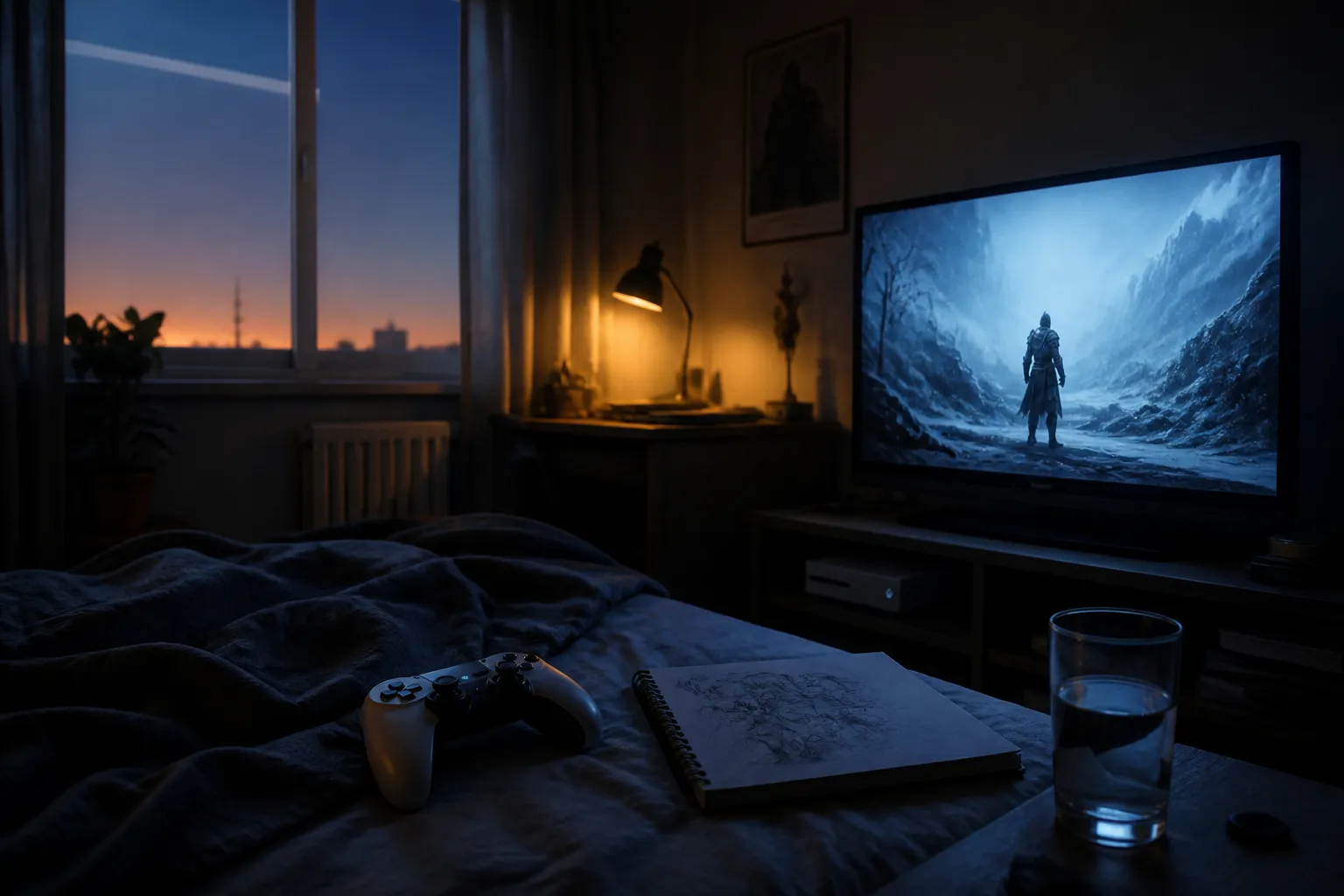
- Make the stop visible. Finish the round, then put the controller somewhere that takes a step to reach.
- Name the return point. Say what you will resume, such as “the next checkpoint,” instead of keeping the whole game mentally open.
- Choose what fills the gap. Get water, step outside, talk with someone, or start the bedtime routine. These are practical options, not treatments or guarantees.
What the teen screen-time research actually counted
A CDC study published in Preventing Chronic Disease on July 10, 2025, looked at associations between screen use and health among US teenagers. Its measure was non-schoolwork screen time, not simply every minute a teen spent looking at a screen. The study defined high daily use as four or more hours. Its data came from the 2021-2023 National Health Interview Survey-Teen, a web-based survey of young people ages 12 to 17. The CDC article describes the survey and findings.
Teens reporting higher non-schoolwork screen use were more likely to report infrequent physical activity, weight concerns, symptoms of depression or anxiety, less frequent social and emotional support, insufficient peer support, and an irregular sleep routine. Those are associations, not proof that screen time produced the outcomes. The available summary also does not provide effect sizes or percentages for these findings, so it cannot tell a family how much more likely any one outcome was.
There is a useful detail in how the information was collected. Teenagers answered the health questions themselves, while parents supplied some other information, such as family income. The CDC authors note that earlier research often relied on parents reporting for their children, which may misrepresent these associations. A teen’s own report is still a report, with limits, but it is not interchangeable with a parent’s estimate.
The heart-health report is a different piece of evidence
An August 6, 2025, American Heart Association news release covered research published in the Journal of the American Heart Association. It reported that more recreational screen time was associated with higher cardiovascular and cardiometabolic risks in children and adolescents. The named risks include high blood pressure, high cholesterol, and insulin resistance. The research analyzed more than 1,000 participants across two studies in Denmark. The AHA release summarizes the findings.
That is not the same sample as the CDC survey of US teens. The AHA release also points to broader context: data from US surveys conducted between 2013 and 2018 found that 29% of American youth ages 2 to 19 had favorable cardiometabolic health. That figure is not a result from the Danish screen-time studies. Keep the samples and claims separate when reading a headline.
The release says the heart-health association was strongest among young people who slept fewer hours. Researchers suggested screen use might affect health by “stealing” time from sleep. The wording matters. The reported link does not establish that screen use caused shorter sleep, or that short sleep caused the measured risks. Nor does the release specify which devices counted, how screen time was measured, or the ages of participants in the Danish studies.
“Screen time” does not mean “gaming” by itself
A game session has a particular texture: thumb pressure on a trigger, a loading screen, the tiny delay before a character responds. The research summaries do not isolate that experience. They discuss screen use or recreational screen time. They do not say whether gaming has different associations from watching video, scrolling on a phone, or using another screen. A claim about all recreational screen use should not be recast as a finding about games alone.
The CDC’s four-hour threshold is a category used in that study. It is not presented as a recommended daily limit. The sources do not offer a specific number of hours families should allow, or a tested plan for cutting back. The careful response is not to turn a research cutoff into a household rule by accident. It is to notice the pattern in a particular home: when play runs late, what gets squeezed out, and whether that pattern is happening often.
That makes a pause useful without making it a diagnosis. “I’m putting it down for dinner” is a concrete boundary. “I’m done with games because they caused this health problem” claims more than these studies show. One is a choice about a session. The other is a causal conclusion the sources cannot support.
Build a pause that has a return point
Stopping can feel harder when the next objective is already glowing on screen. Give the pause a small, specific shape. Finish the current round if that is practical, save where the game allows, and say what comes next: “I’ll pick up at the checkpoint tomorrow.” Then put the controller out of immediate reach. The point is not to make a grand promise. It is to make the break legible to everyone in the room, including the person who wants to keep playing.
For a teen, a parent can ask about the session without turning the question into a trial: “What were you hoping to finish?” followed by “What needs the next hour?” That leaves room for the game to matter and for sleep, activity, and relationships to matter too. The CDC findings include associations with each of those areas, but they do not tell an individual family what is happening in its own routine. A conversation and a simple session log can show the local pattern more clearly than a headline can.
Try logging only a few details for several sessions: approximate stop time, whether the play was recreational, and what you intended to do afterward. This is an observation exercise, not a medical test. If worries about sleep, mood, activity, or health persist, a family can raise them with a qualified health professional. The sources do not prescribe a screen-reduction method, so treat any household experiment as a practical choice, not a proven intervention.
Close the session, leave the door open
The run can wait at a checkpoint. The screen-time evidence offers a reason to notice how recreational use fits around sleep and the rest of a teen’s day. It does not establish that gaming itself causes the reported outcomes, and it does not set a universal number of hours. When the controller goes down tonight, what will the pause make room for, and what would tell you it is time to pick the run back up?
Please seek a professional. This article is general information, not legal advice. Please seek a licensed attorney in your state about your own situation.
Sources
- Associations Between Screen Time Use and Health Outcomes Among US Teenagers
- Excessive screen time among youth may pose heart health risks | American Heart Association
- Digital Behaviors and Health | Healthy Schools | CDC
- CDC Data Show Encouraging Progress in Youth Health | CDC Newsroom
- Physical activity
- Recommendations for Physical Exercise as a Strategy to Reduce Problematic Use of the Internet and Digital Devices: A Perspective - PMC
- https://vertexaisearch.cloud.google.com/grounding-api-redirect/AUZIYQFYMMIfw1rykDWFkO8JTGzqZKblEBFs0gPeK3VhvA_8ChWX0lYg0bF8gDVIKK4IUgPxaOmkfm4phH3FLK5EBhXICk7IE7qrT8AUQt937WDD-xQKQtdVEjfyoZB6PB-wYman1-z-Y6OWHjAcQm14D2ZuJHETP4cFH5eciJGdNVz2UkPg5ADPQ3EZjqgaRwNKe104pgGvOwVs6sIs4CyBbH1KghJly-_DFLOfxrsd6SjWaY-1GGIdI79cH9rtiB1_Dv8XjS_3VPI5ZmXPASffPxzJDJfn3LiVhXQPbl4ZRbontVcokJocasDSFChwcw==
- Tips for marathon recovery — and starting a plan for the next one - Mayo Clinic Orthopedics & Sports Medicine

He is a house writer for GamesUnlimited. He covers co-op campaigns, controller design, and player rituals through reports from launch nights and living rooms.