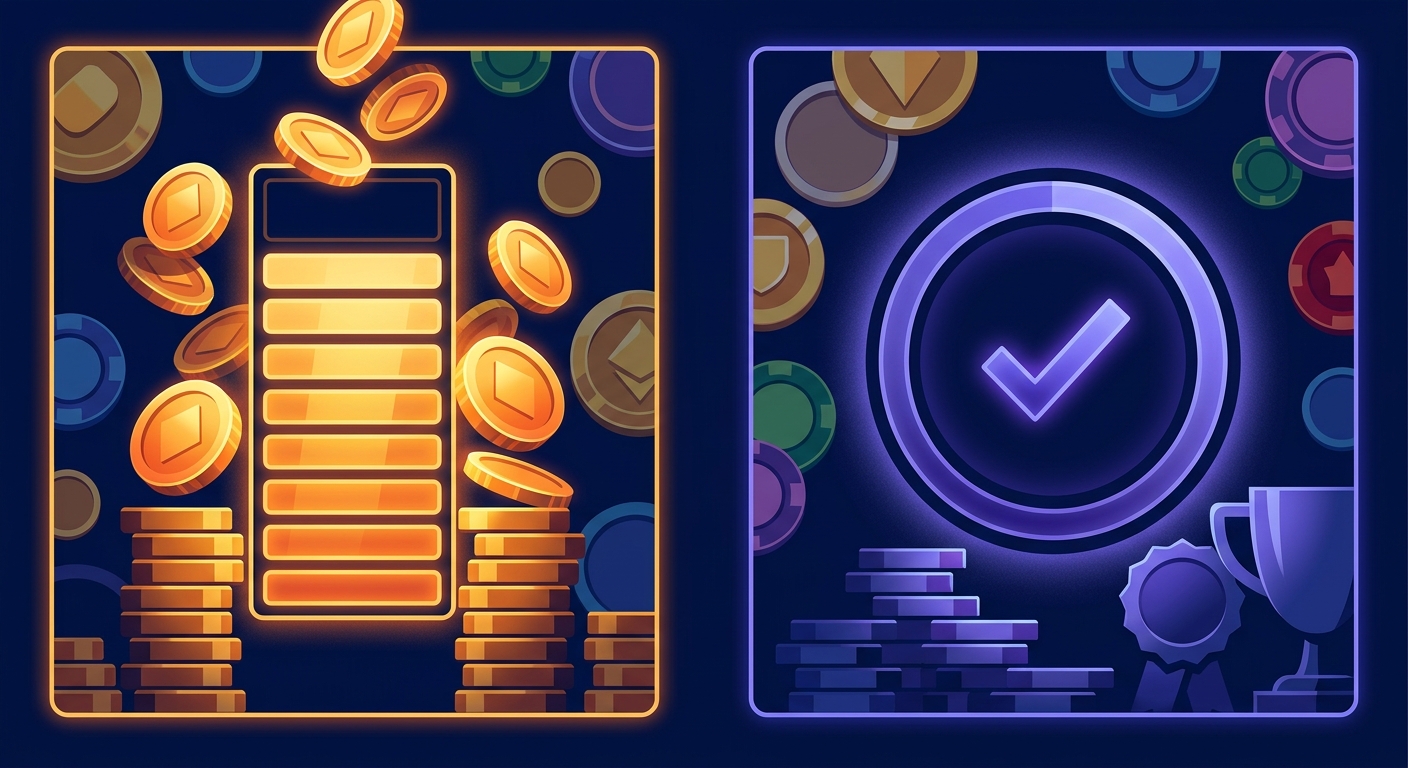
A "one more round" game needs two economies to balance. The visible one pays out points, currency, upgrades, or rank. The quieter one spends the player's time by keeping the next reward close enough to pursue. A clean stopping point appears when a round has paid what it promised, and the next round asks for a fresh decision instead of quietly carrying forward a debt.

The basic gameplay loop is usually described as an action, a reward, and a prompt to act again. That cycle is useful design, not a problem on its own. The trouble starts when every reward also opens a new partial goal: one more match to finish a quest, one more run to reach an upgrade, one more attempt to protect a streak.
Those goals borrow force from unfinished business. A visible progress bar makes the remaining distance easy to calculate, and it can make stopping feel like abandoning value already invested. Variable rewards add uncertainty: the next run might be ordinary, or it might produce the rare drop that has not appeared yet. Neither mechanism proves that a player cannot stop. Together, they make the choice more costly to evaluate in the moment.
That tension is already present in industry language. A gameplay-loop guide from Supersonic frames repeat play as a retention and monetization goal. That is a clear business objective. It is not, by itself, a measure of whether the player leaves satisfied, or whether the loop has made leaving feel like a loss.
The loop that was never meant to end
Arcade games had a practical boundary built into their economy. A player ran out of lives, completed a level, or ran out of coins. The cabinet could keep offering play, but the current attempt had reached a legible result. Software does not need a coin slot or a final life, so modern games can keep the loop running through menus, daily objectives, unlock tracks, and live events.
Each layer changes the cost of ending a session. A completed match may still feed a battle pass. A finished stage may unlock a timed bonus. An account-level reward may sit one bar away. These systems can coexist, but when all of them advance at different rates, the player has no single answer to the question, "Am I done?" The game has converted one round into several overlapping contracts, none of which closes at the same moment.
Designers often treat session length as a retention signal, and longer play can indicate that a loop is working. But the metric does not explain why the session continued. A player may be absorbed in a well-paced run, or may be chasing a milestone placed deliberately just beyond the previous result. Those outcomes look similar in a dashboard. Their consequences differ when the player returns tomorrow.
Unfinished goals change the price of pausing
Visible, nearly completed goals can keep a player focused on the next action rather than on the question of whether to stop. This is not a universal compulsion. A progress bar does not force anyone to continue. It does make the remaining work concrete, which is why a quest at 90 percent can feel more urgent than a new quest at zero. The distance is short enough to calculate, and the sunk effort behind it makes leaving feel like it costs something real.
Timing systems add another cost. A streak that expires at midnight, a bonus that refreshes in an hour, or energy that is almost full can make leaving feel wasteful. The player is no longer comparing the fun of another round with the value of stopping. They are also accounting for a threatened reward. If the game resets a multiplier on exit, it turns a completed session into a loss on the ledger, not a neutral pause.
A healthier model separates rewards for participation from penalties for absence. A streak can record completed sessions without demanding daily attendance. An energy system can fill while the player is away, with no overflow penalty for waiting. A limited-time event can disclose its schedule early and avoid placing the final reward behind a last-minute grind. The key test is simple: does the system give a benefit for returning, or remove something because the player stopped?
Make the end of a run resolve
A clean stopping point is a designed state, not a default. The round is complete, its rewards are settled, and the player can understand what happened without opening another menu. A useful end screen shows the result, the earned currency, and any progress made toward a longer goal. It does not hide a meaningful payout behind an immediate "play again" button that skips the accounting.
Session framing helps. A run with a clear beginning, objective, and result gives the player a unit of play that can feel complete on its own terms. A roguelike can offer a summary after defeat, including unlocked items and the next available route. A competitive game can settle rank changes before presenting matchmaking. The next session can be offered clearly, but it should begin as a new choice rather than the default continuation of an unresolved process.
Small balance changes can shift the exit ramp in either direction. Consider a patch that reduces currency earned on a loss while leaving a quest objective one match away. The nominal round still ends, but the economy has made the next round more attractive and the completed one less rewarding. A different patch could award a modest completion bonus, show quest progress on the results screen, and let the player claim it before queueing again. The same amount of play can then feel like a finished unit rather than a deposit toward the next one.
Build an exit ramp into the reward curve
Goal legibility comes first. Players should be able to tell how long a run usually takes, what counts as completion, and whether leaving now costs them anything. If an objective spans several sessions, show that openly. Disguising a long-term track as a short task that repeatedly stops just before its payout is the design equivalent of a disappearing finish line: the player keeps running without ever getting to stop cleanly.
Rewards should be tuned around completed units. Give a run a coherent payout, and let longer-term progress accumulate without requiring the player to continue immediately. If rewards diminish after a natural endpoint, explain the curve and keep the completed session worthwhile. A sharp cliff can feel punitive. A transparent taper signals that extra play is optional, which changes the psychological weight of choosing to continue.
Re-engagement messaging follows the same principle. A reminder that a new event has begun gives information. A warning that a streak is about to vanish applies pressure. The first helps a player plan another session. The second makes absence feel like a mistake. These choices affect the economy as much as reward rates do, because they set the perceived cost of waiting and raise the floor on how long a session needs to be before it feels worthwhile.
The exit ramp is part of the economy
For a live-service game, a natural stopping point may look like a short-term loss: fewer rounds today, fewer immediate impressions, less activity on a daily chart. The longer-term question is what the player associates with returning. If every session ends with an unpaid objective, a disappearing bonus, or a queue prompt before the results have settled, the game is asking attention to cover a design debt that never quite clears.
A resolved round lets the player leave with a clear account: what they did, what they earned, and what remains for another time. That does not force a stop, and it does not weaken a compelling loop. It makes continuation voluntary. The most useful retention signal is not simply that a player stayed for one more round. It is that, after a complete round and a visible chance to leave, they chose to start the next one.
Sources

Jonah Bell is a house writer for GamesUnlimited who covers strategy games, simulation design, and player economies. He follows systems from tutorial to endgame, testing how patches reshape the choices players make.