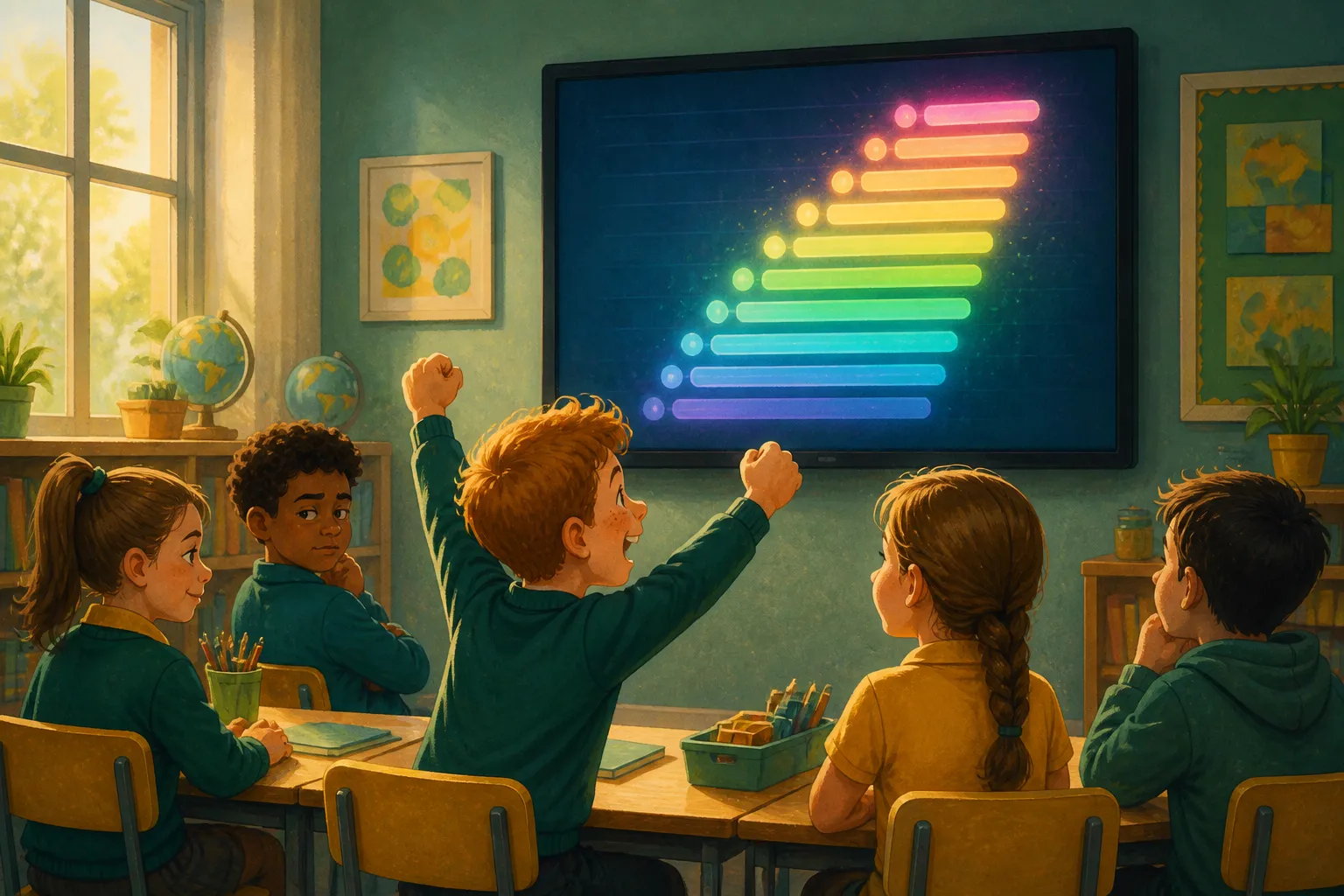
The round ends. A score lands, the board opens, and somebody leans closer. "Where am I?" comes first. "Can I pass them?" follows before the next round has loaded. A full leaderboard makes that second question feel automatic, because it lists every player in score order instead of stopping at the top ten.
The number beside your name
Picture a group finishing a short game session. One player finds their name near the top and taps for another go. Someone farther down scans the list, spots a friend, and starts working out the gap. A third player looks at the same board and wants to close it. Same screen, different invitations. This scene is illustrative, not drawn from the study.
Designers often use rankings to make competition feel immediate. A place on the board gives a score some context, and the next round becomes a chance to move. A ranking also makes comparison hard to avoid. On an infinite leaderboard, every player can see where they stand, including players far below the leaders. That visibility cuts both ways.

A maths game, six weeks, 1,389 students
A study of Seven Spells, a digital maths game, followed 1,389 Irish primary school students through a six-week programme. The researchers looked at how students experienced an infinite leaderboard, which shows all players in ranked order. They gathered player traits and opinions through questionnaires and surveys. The results describe what students reported, not a record of every moment they spent playing.
The paper appeared in the International Journal of Serious Games in 2024. Leaderboards are often added to raise motivation through competition. The study asks a narrower question: who enjoys being ranked, and who does not?
The answer was not simply "the players at the top." Enjoyment of the leaderboard was shaped by a player's position on the board and by their level of maths anxiety. How much students liked playing against one another also significantly predicted how much they enjoyed the leaderboard. The board met the player's feelings about the subject and about rivalry.
Position changes the view
Rank gives the same score a different meaning. A player near the top sees a short climb to first place. A player near the bottom may see a long line of names between them and the leaders. An infinite board keeps both views in frame. It does not hide the lower positions behind a cutoff, so the distance stays visible.
Maths anxiety mattered beyond where a student sat. Maths-anxious players disliked the leaderboard more than non-anxious players, even after the researchers controlled for leaderboard position. A low rank can discourage, but rank alone does not explain the experience. A player can be uneasy about comparison even when position is held constant.
Think about the result screen. The player reads the number, then reads the names around it. One person treats the gap as a target. Another may read it as a public measure of how they are doing at maths. The scoring rules have not changed, but the screen has made a different part of the experience loud.
Rivalry is a preference, not a default
Students who liked playing against each other were more likely to enjoy the leaderboard. A competitive board will therefore suit some players more than others. "Run it back" can be an invitation for one child and a reason to drift away for another.
The study also found only a small correlation between leaderboard enjoyment and overall enjoyment of the game. Liking the board did not strongly stand in for liking the game. A player might enjoy chasing a rank while feeling neutral about the rest of the session. Another might enjoy the maths but dislike the comparison. Those are separate responses, and they can be measured separately.
A team weighing a ranked screen can ask three practical things before shipping it:
- Does the board show all players, or a limited view that spares lower-ranked players?
- How does a player near the bottom feel about the next round?
- Is the board meant to encourage rivalry, practice, or a sense of progress?
The screen can signal all three, but it cannot make every player read it the same way.
What this study can and cannot settle
These results come from primary school students playing a maths game. They do not show how adults will respond to an arcade game, a casual browser game, or a leaderboard among friends. Maths anxiety is specific to the subject, and the players were children in a structured six-week programme.
The research examined infinite leaderboards. It does not say whether a capped top-ten list, a friends-only ranking, or a personal-best display would ease the same concerns. Those formats change who appears on screen and which comparisons are possible. Their effects would need testing, not assuming.
The link between leaderboard enjoyment and overall enjoyment was small. The findings support caution, not a universal verdict. They give designers a reason to check how different players experience a board, especially players who feel anxious about the subject or dislike direct comparison.
Before the rematch button
A scoreboard can turn one round into a rematch by putting a clear target beside the score. That target might be a rival, a position, or a reminder of the distance left to climb. In this study, responses varied with rank, anxiety, and appetite for competition.
So look at the result screen from the bottom of the list. If the only thing it says is how far away everyone else is, the rematch button may not feel like an offer.
Sources
- Exploring the Impact of Player Traits on the Leaderboard Experience in a Digital Maths Game | International Journal of Serious Games
- https://vertexaisearch.cloud.google.com/grounding-api-redirect/AUZIYQGCeg-lY8lH2MO2_ESLzLOKmqeweYNYoEhMRBBCA270LDDfevDmUhs8jwiCRP3X-rfoh9HmjNu4Yah3lHVbt5vTd1oTMdGUgWwOI7zvvoJ39zg9rsMx5idkTPwRRugMCxyAUULg-mt6PCkjbcsJimzEQXRsLMdurYQWMpGE9gWLnY2SYfSMoRIshoj1Seh14BBex0AWA0etJ1yf9X6HnxKU20UXkyLpv1iB4PYDaF8w1LZw6W2zSfjYVun-xKRWlLFG2QBmr-6Xpm4GI6Ei996C88PYfZA2kTFW1UjAmPRtiIt7hs8n_eJv9GK6kDxxccb1XCzj4X6ts5xf9-BcGe0OnkSR6xwz20DnPrUjEQ==
- Social media, online games and search engines - European Commission
- Product characteristics and risk
- Dark Patterns in Gaming: Lawsuits Target Manipulative Monetization Tactics | Rain Intelligence
- Gaming | Federal Trade Commission
- Banking in video games and virtual worlds | Consumer Financial Protection Bureau
- Motivational strategies and approaches for single and multi-player exergames: a social perspective - PMC

He is a house writer for GamesUnlimited. He covers co-op campaigns, controller design, and player rituals through reports from launch nights and living rooms.