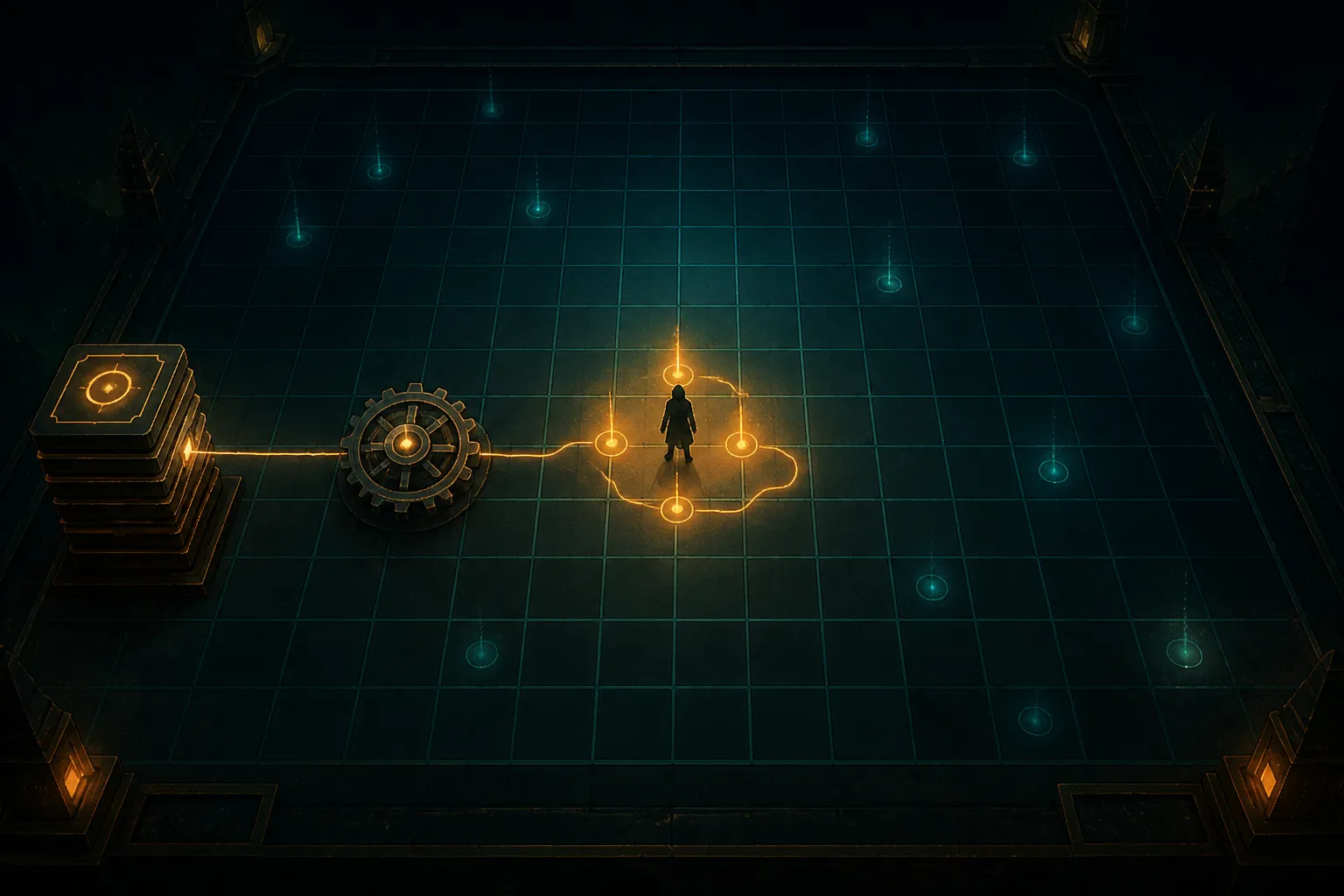
A failed arcade run creates two costs. The player loses the attempt, then waits to make another one. The first cost belongs to the game's challenge. The second belongs to its pacing. A fast restart is part of the playable loop, not a courtesy screen after the loop has stopped.

The loop includes the time between attempts
Think of a short arcade round as a sequence: start, act, fail or finish, read the result, start again. Designers often focus on the action, where the player steers, jumps, aims, or manages a timer. But the sequence also includes the handoff after failure. If that handoff asks for a long wait or several separate inputs, the player spends more of the session outside the activity they came to repeat.
That does not mean every pause is waste. A result screen can show a score, explain a mistake, or give the player a moment to decide whether to continue. The design question is what the pause does. If it gives useful information, it earns its place. If it only separates a lost attempt from the next one, it is hard to justify in a game built around short rounds.
Restart speed also shapes how often a player can test an idea. Say a run ends after a missed jump. On the next attempt, the player may change the timing or route. A short interval lets that decision meet the game quickly. This is a design argument, not a measured finding. We have no data here showing that faster restarts make people play longer or improve faster. The argument rests on one plain question: how much of a session is spent acting, and how much is spent getting permission to act again?
Failure has an economy
Every retry has a small cost in attention and time. That cost shapes which experiments feel worth making. If another attempt is one press away, a player can try a narrow adjustment: move earlier, take a different lane, wait for a safer opening. If restarting is cumbersome, the player may start protecting the current run instead. That is a plausible effect of friction, not a universal rule about player behavior.
Faster is not always better. A game may want a failure to carry weight. A survival mode might make recovery scarce. A tactical challenge might ask players to review a plan before restarting. In those cases, a delay or an extra confirmation can support the intended stakes. The useful distinction is between friction that expresses a game rule and friction that adds no decision.
This helps a team make a more precise tradeoff. If the player needs to choose a loadout, inspect a replay, or understand a changed condition, the post-failure phase has a job. If no meaningful choice is present, shortening it keeps the game's rhythm without softening the challenge. Every unnecessary step delays the next playable decision.
How to audit a restart flow
Start by timing it. Record the gap from the moment a run ends to the first moment the player has control again. Then split that gap into three parts: technical loading, screens that carry information, and screens that only ask for a confirmation. Each part has a different fix, and cutting all of them at once can remove information the player values.
- Count the inputs between failure and control. Fewer is better unless an input carries a decision.
- Mark which screen holds information the player needs, such as a score or a cause of failure.
- Check whether a confirmation prevents accidental resets or just repeats a choice already made.
- Separate loading from deliberate pacing, since only one of them is an engineering problem.
A team can then compare two builds with the same challenge but different restart paths, and watch whether players choose to retry. Those measurements would not explain why behavior changed. They would give designers a firmer basis for the next question.
Patch the handoff, not the challenge
When a restart feels slow, trace the sequence before assuming the level needs to be easier. A change to restart flow should be written down like any other patch: fewer menu steps, a clearer retry prompt, a shorter transition. Then watch for side effects, including accidental retries, missed score information, or a shift in how often players continue.
The goal is not to make failure weightless. It is to make the interval after failure match the rhythm the game wants. For a compact browser arcade game, that means treating the route back into play as part of the core loop and checking each delay for a job. Whether this improves retention is a question for testing. The time between attempts is already part of the experience being designed.

Sources
- https://vertexaisearch.cloud.google.com/grounding-api-redirect/AUZIYQFcF6Nb-UcdCsYhCxQtkZoy53HnxEoaW9Ed9-qrK2z-eydFTEcygwcm2h9vp7CI5S1ESijiHIERwJ9cGRV8KsnUgd8Ex3EEJOB50cA7Euu7mha-QJV5c45Fjj1l42bzPyRj3AT21yk75c6pffJZUjNO4PFQiCbTYLAly7Xk
- Designing An Awesome Video Game
- Can approachability 'fix' Dark Souls?

Jonah Bell is a house writer for GamesUnlimited who covers strategy games, simulation design, and player economies. He follows systems from tutorial to endgame, testing how patches reshape the choices players make.