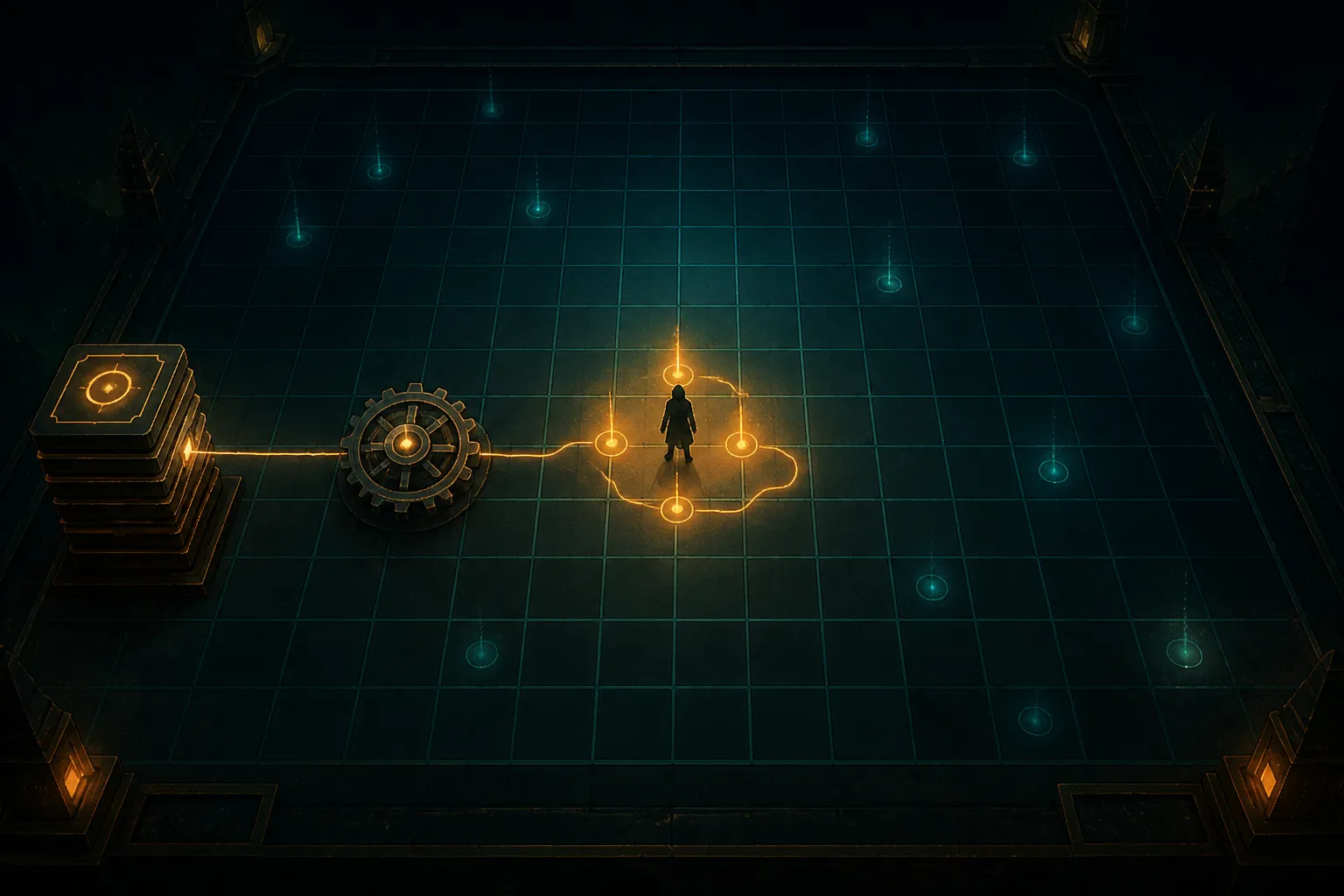
A balance update can change the best route without changing the destination. In Heroes of the Storm, Xal'atath’s October 5 hotfix narrows one teleport, lowers missile damage, and changes how quickly charges build. For Minecraft speedrunners, a seed’s value depends on the route it offers through food, lava, and Nether structures, and on which game version is running. In both cases, the practical question is not “What used to work?” but “Which costs now sit on the critical path?”
- Read the new constraints. For Xal'atath, compare the live ranges, damage, and charge rules with the old plan. For a Minecraft seed, verify its exact version and check what it offers in the opening minutes.
- Reprice the route. A shorter teleport or weaker missile changes the value of a risky approach. A long food detour or awkward portal site spends time that a seed cannot refund.
- Test the first split. If the opening sequence no longer produces the position, resources, or timing the plan requires, revise early rather than building the rest of the run around it.

- Separate verified values from reports. Patch notes establish the listed changes. Player reports say some in-game tooltips did not match them.
- Keep version-specific evidence. A seed recommendation without a patch number, or a build plan based on an outdated tooltip, may describe a route that no longer exists.
- Judge the consequence. The best route is the one that still meets its timing and safety requirements, not the one with the most impressive isolated move.
A hero route has a new price
The hotfix changes several parts of Xal'atath’s route at once. Void Step’s targeting range falls from 5 to 2, while its teleport point distance drops from 7 to 6.5. Those are separate constraints: the ability can be aimed from less far away, and the destination distance is also slightly shorter. A route built around reaching a distant target or escape point needs to be checked against both values, not just one.
Void Volley takes a direct damage cut, from 90 to 72 base damage per missile. Charge generation also changes: Basic Attacks against enemy Heroes grant one charge, while attacks against non-Heroes grant one charge every two attacks. That makes target choice part of the economy. A plan that previously built charge while hitting non-Heroes at the same pace as before will now need more attacks, or a different source of pressure. The notes also report lower Void Eruption damage, down 20 percent when uncharged and 5 percent when fully charged. Taken together, the changes reduce some immediate output and make the route to charge more important.
There are counterweights. Shadow Mark’s Void Orb speed increased slightly, Anchored Core’s Level 1 radius bonus was cut from 50 percent to 25 percent, and Silence of the Lamb at Level 7 now lasts 1.5 seconds instead of 1. Those numbers affect different decisions, so they should not be compressed into a simple verdict that the hero is stronger or weaker. The useful test is whether a specific sequence still reaches its target, keeps the required space, and generates enough charge for the next ability.
Control timing is part of the route
The patch notes add an important interaction with Time Stop. Xal'atath’s orbiting orbs pause during the effect and resume afterward. Void Eruption can be cast or released during Time Stop, but a release is queued until the effect ends. A new Ability order, movement order, or attack order cancels a pending cast or queued release.
That turns input discipline into a resource. A player can plan around the queued release, but must avoid issuing another order that cancels it. The route is not only a sequence of locations and cooldowns. It includes the time spent waiting and the commands that must be withheld. This matters especially when a player has a familiar habit of moving or attacking during a pause. If that habit cancels the setup, the intended payoff never arrives.
There is a verification problem, too. Forum users reported that the in-game tooltip for Void Eruption had not been updated, and one report said Silence of the Lamb displayed a two-second duration even though the notes say 1.5 seconds. The available information does not establish whether a later hotfix corrected those displays. For route planning, keep the patch note and the reported tooltip discrepancy separate. Do not treat an unverified tooltip as proof of the live value.
A seed is a schedule, not a screenshot
The Minecraft speedrun guide evaluates seeds by the work they remove from an opening route. It points to fast food, access to lava, and a clean route into the Nether with useful fortress and bastion prospects. Its opening checklist looks at food, wood and stone, a lava plan, iron probability, and terrain friction. These details shape the first 90 seconds, when a seemingly small detour can change the pace of the whole attempt.
The Nether checklist asks different questions, including spawn biome, dual-structure potential, travel safety, and a backup plan. The guide frames the first five minutes after entering the Nether as a key evaluation window. A seed can look attractive in a screenshot and still charge the runner in extra travel, uncertain structure access, or a weak fallback. A good route reduces chores and risk at the same time.
Version labels are part of the evidence. The guide warns that seed stability can shift between minor versions and recommends recording the exact patch number. It cites a March 2026 estimate for version 1.26.1, “Tiny Takeover.” A seed list without a version may therefore be describing a different starting system from the one a runner will load. Keep separate notes for different versions and categories, such as random-seed practice, no-reset attempts, and co-op races, rather than assuming one route serves every goal.
Rebuild from the first failed assumption
In both games, the cleanest update method is to find the first assumption the new information breaks. For Xal'atath, that might be a Void Step reach, a damage threshold, a charge count, or a queued release that is vulnerable to a stray command. For a seed, it might be the time required to secure food, the availability of lava, or the safety of the Nether entry. Change the plan at that point instead of preserving a route whose later steps depend on a missing condition.
Use early tests to decide whether to continue. The Minecraft guide recommends resetting when the first split already feels like a salvage run, because consistency matters more than a dramatic recovery. In a hero match, the equivalent check is whether the revised ability timings and ranges still support the intended engagement. That is a practical comparison, not a claim that the two games have identical systems: one route is shaped by player inputs and a balance patch, the other by generated terrain and version stability.
The verdict is consequence-based. For Xal'atath, verify the live reach, damage, charge pace, and Time Stop interactions before relying on a familiar combo. For Minecraft, confirm the patch number and judge the seed by the opening resources and structure route, not its image. A balance update rewrites the best route when it changes what the next step costs. Find that cost early, then decide whether the route still earns its time.
Sources: Heroes of the Storm Xal'atath hotfix notes and Minecraft speedrun seed guidance.
Sources
- 2026-10-05 "Hotfix" - Xal'atath Balance Patch Notes - General Discussion - Heroes of the Storm Forums
- Minecraft Speedrun Seeds: 2026 Picks - Minecraft.How
- Zfg - Wikipedia
- Megabonk Progression Guide & Final Swarm Strategy
- Minecraft Speedrunning Explained — Craftdex
- Dig to Escape World Record: Fastest Escape Times & Speedrun Tips - Dig to Escape Wiki
- Path of Exile 2 Speedrun Guide: Preparing for Patch 0.2.0
- Last Epoch Season 5 Leveling Guide: Fast Campaign to Monolith Speedrun (Patch 1.5) • 2UpSkill

Jonah Bell is a house writer for GamesUnlimited who covers strategy games, simulation design, and player economies. He follows systems from tutorial to endgame, testing how patches reshape the choices players make.