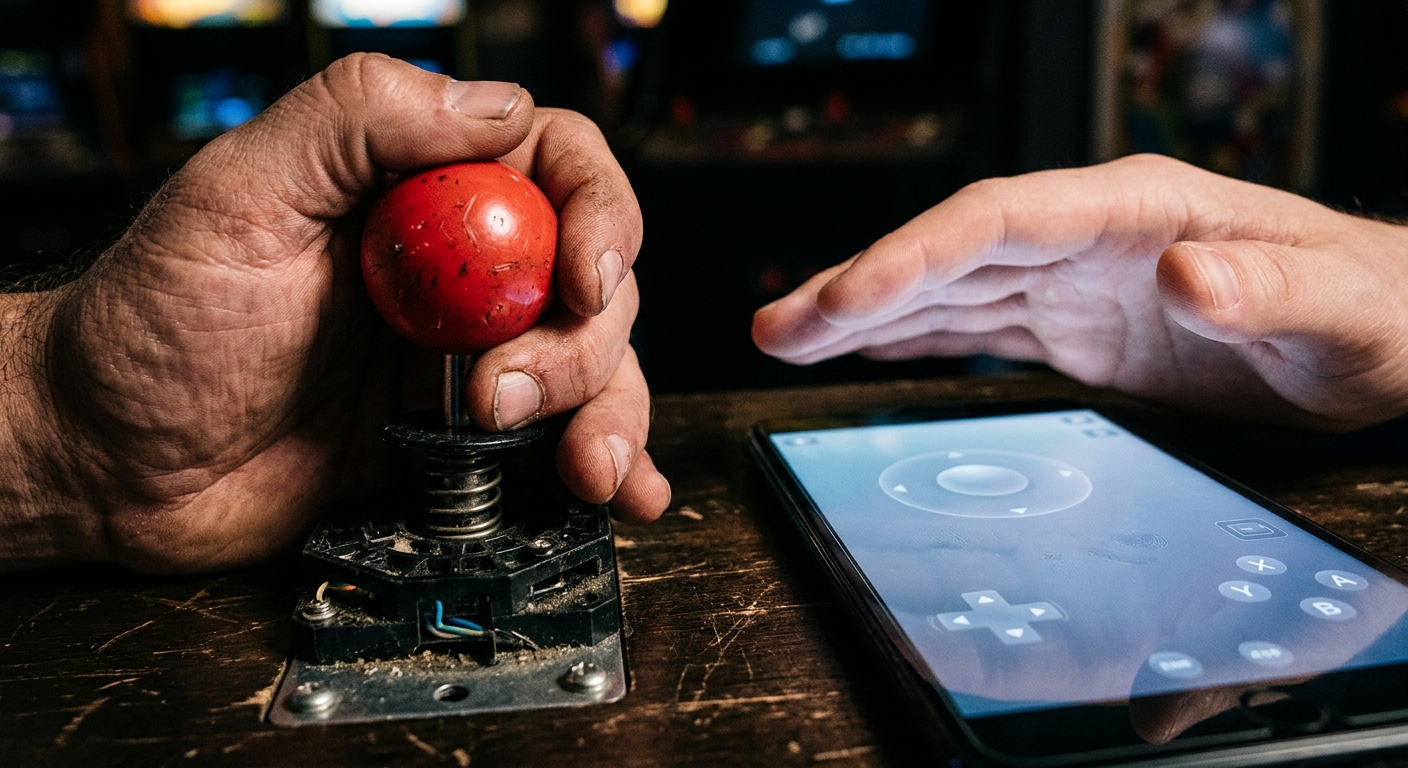
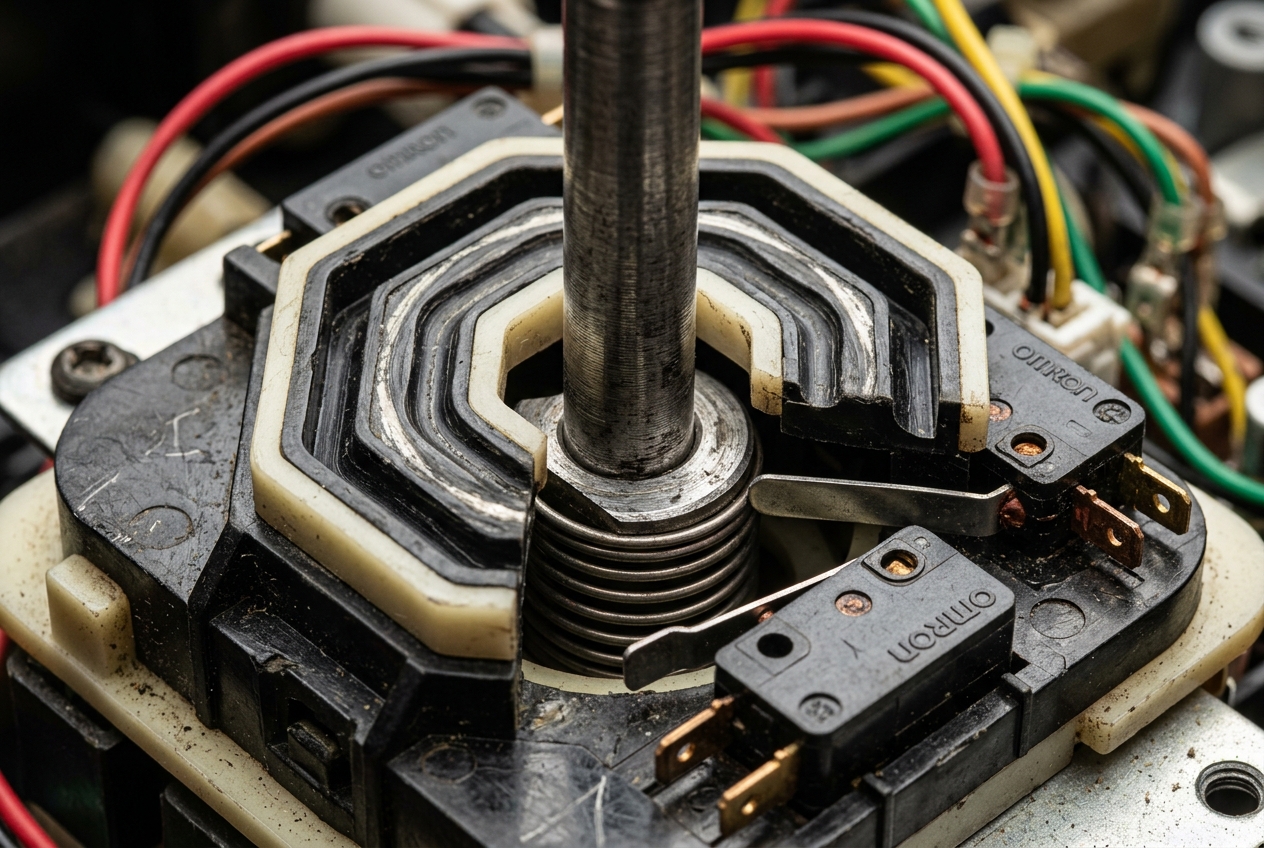
There is a moment every arcade technician recognizes. A player steps up to a cabinet, grips the stick, and within two seconds their shoulders drop about half an inch. The tension leaves. The body has already confirmed, without any conscious check, that the hardware is where it should be and will do what it is told. That small exhale is not relaxation. It is trust, transferred through a spring-loaded gate and a pair of microswitches into the player's palm. Touchscreen virtual sticks have never once produced that exhale, and the reasons why go deeper than anyone's preference for plastic over glass.
Arcade engineers spent decades solving the problem of translating human intention into game input. Touchscreens arrived and quietly asked everyone to forget the solution.
The Physical Feedback Loop That Arcade Hardware Took for Granted
Every joystick ever bolted to a cabinet operates on a principle so obvious it almost escapes notice: the stick pushes back. That resistance, the spring tension, the gate click, the microswitches snapping underfoot, creates a continuous conversation between the player's hand and the machine. You do not have to look at the stick to know where it is. Your palm already knows. Proprioception, the body's internal map of its own limb positions, handles that cognitive load silently and for free, leaving the player's eyes to do the one job that actually requires them.
This feedback loop is not a luxury feature. It is the foundational architecture of physical control. Pinball plungers, spinner knobs, trackballs, throttle levers, every input device in arcade history has been built around the human body's expectation of resistance, travel, and tactile confirmation. The hand reaches, the hand feels, the hand knows. That circuit closes in milliseconds and costs the player nothing in terms of conscious attention. The designers who bolted those first sticks to plywood cabinets in the late 1970s were not making aesthetic choices. They were solving an ergonomic problem with the most direct possible answer.
What a Touchscreen Actually Offers in Place of All That
A capacitive touchscreen detects the electrical disturbance of a fingertip against glass and translates that contact point into an X/Y coordinate. That is, in its entirety, the feedback mechanism available. The surface does not depress. It does not click. It does not push back. From a haptic engineering standpoint, it is a frictionless void that happens to register presence. Asking this surface to simulate a joystick is not unlike asking a photograph of a staircase to support weight.
Virtual sticks drawn onto touchscreens attempt to solve this problem through visual representation alone. A rendered circle, a rendered nub, motion implied by graphic design. The player is expected to anchor their thumb to an invisible point on an undifferentiated glass surface and maintain that anchor through sustained muscle memory alone, without any physical reference to confirm the thumb has not drifted. It frequently has drifted. The thumb always drifts. Glass offers no reason for it not to. I have watched a good player, someone who can nudge a pinball machine at the exact right moment without tilting it, go completely cross-eyed trying to run a mobile shoot-em-up for more than four minutes without checking where their thumb actually was.
Latency, Drift, and the Compounding Cruelty of Soft Inputs
Beyond pure haptics, virtual controls introduce a latency chain that hardware sidesteps almost entirely. A joystick switch closes, sends a signal, and the game responds. The chain is short and deterministic. A touchscreen input must be sampled by the digitizer, interpreted by the operating system's touch stack, passed to the game engine's input layer, and only then translated into character movement. Each handoff is a small opportunity for a frame-level delay. Individually, these delays are often small enough to dismiss. Collectively, under the fast reflex conditions that arcade-style games demand, they are felt as something between friction and betrayal.
Drift compounds this in a way that feels almost personal. Because the virtual stick has no physical home position the thumb can locate by feel, slight unintentional displacement accumulates invisibly. In a tense moment, a fast-approaching enemy, a narrow gap, a timed jump, the player's thumb may be a centimeter off the notional stick center without knowing it. The resulting input mismatch arrives not as a readable error but as a mysterious, humiliating failure. The game did exactly what the thumb told it. The thumb, unfortunately, was lying. There is no repair for that. You cannot replace a spring you cannot hold.
Why Arcade DNA Makes This Particularly Painful
The genres that migrated most eagerly to mobile, shoot-em-ups, beat-em-ups, platformers, twin-stick shooters, are precisely the genres engineered from the ground up around precise, high-speed physical inputs. Their difficulty curves, their enemy patterns, their scoring systems, their entire sense of flow were calibrated against the assumption that a player's directional input would be immediate, accurate, and physically confirmable. Porting these games to touchscreens does not merely change the control method. It changes the implicit contract between the game and the player, quietly and without acknowledgment.
The result is that games which feel exhilarating on a stick feel punishing on glass, not because the player has become less skilled, but because the information architecture of the control scheme has been gutted. Arcade design assumed the hand would always know where it was. Touchscreen design asks the hand to pretend. For short, casual sessions the pretense holds well enough. For anything demanding the sustained precision that arcade culture was built around, the glass wins every time, and the player absorbs the loss as personal failure rather than structural design. That is the unkindest part of the whole arrangement. The stick never let you wonder whose fault it was.
Sources
- 404-Error
- How PC Players Can Get Better Controls and Performance From Mobile Games - COGconnected
- android controller touch mapping guide to better mobile gaming control – INAIRSPACE
- 404-Error
- https://arxiv.org/pdf/1611.08520
- Get Console-Level Controls on Mobile With Bluetooth Controllers | Turtle Beach
- One-Line Mobile Control Fix - bHopper: Hunted (Game in Development) by lovemakeshare

Marguerite Osei is a house writer for GamesUnlimited covering classic arcade cabinets, pinball, and the hardware that keeps them running. She spent two decades repairing machines in family arcades before she started writing about them. Her reviews weigh how a game plays against how well it holds up to a thousand quarters.